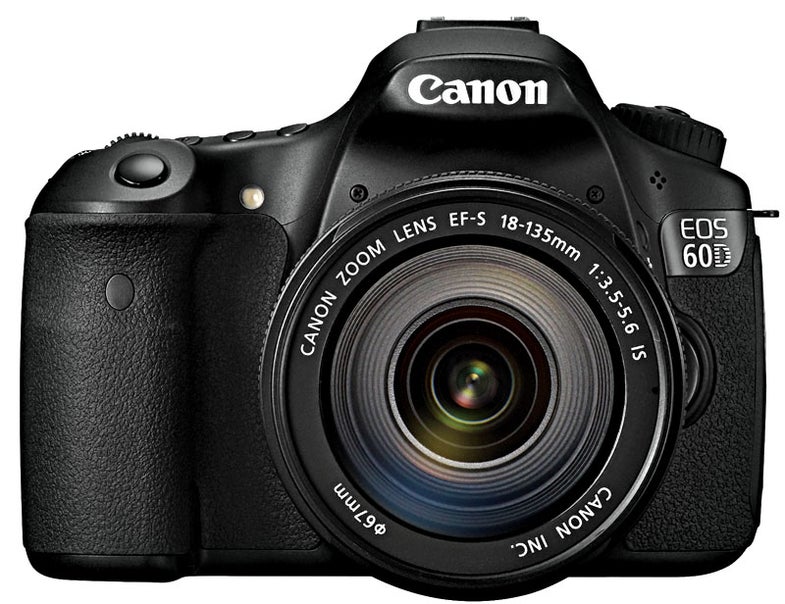
A few months ago, we spent several days shooting with a preproduction sample—a not-quite-ready-for-prime- time version—of Canon’s EOS 60D ($1,100, street, body only), and described our favorable first impressions in the October 2010 issue of the magazine.
But now that we’ve been able to see how a full production model performs in the Popular Photography Test Lab, it’s clear that this 18MP Canon is going to be a big star.
Canon positions the 60D in a midlevel niche between its consumer-oriented Rebel line and more rugged and pro- oriented 7D. The only truly direct competitor for this successor to the popular 50D is Nikon’s new D7000 (Lab test coming soon).
In the Test Lab
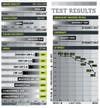
In overall image quality, this time around it’s Canon’s turn to shine, with an Excellent rating from ISO 100 through ISO 800, based on our tests. The Nikon, with a 16.2MP sensor and slightly more noise, scored Extremely High in the same ISO range, just a notch behind.
In our resolution test, the 60D turned in an Excellent 2600 lines per picture height. Plus, it did an admirable job of holding onto that resolution as ISO increased maintaining 2500 lines at ISO 6400 when using the manufacturer’s default level of noise reduction in converting 14-bit RAW images into 16-bit TIFFs. At the camera’s top sensitivity setting of ISO 12,800, under the same test conditions, resolution dropped to 2330 lines, still enough for an Extremely High rating on our scale.
Color accuracy was a much closer race. Both the Canon and Nikon scored Excellent, with a negligible difference in average Delta E, a measure of color variation.
In noise suppression, the 60D pulled a surprise upset. Canon managed to keep noise lower at its default settings than Nikon did, despite the 60D’s extra megapixels. In our test, the 60D scored a Low or better ratings from ISO 100 through ISO 800. It didn’t reach an Unacceptable rating until ISO 6400, while the D7000 did so at ISO 3200. In fact, the Canon turned in lower noise results at every ISO the two cameras share, except at ISO 800, where they tied. (The 60D doesn’t go past ISO 12,800; the D7000 reaches one more stop to ISO 25,600.)
We do all of our tests using the manufacturer’s default setting in its own RAW conversion software. Both the Canon and Nikon RAW conversion software leave plenty of room for extra noise reduction for your images—but you’ll likely sacrifice some resolving power.
When it comes to autofocus, the 60D isn’t the fastest on the market at the brightest portion of our test—honors there go to the more expensive Olympus E-5 and less costly Sony Alpha 55. It squeaked ahead of the D7000 by just a few hundredths of a second down through EV 4. Once we turned the lights down to EV 2 (think a dimly lit interior), the Canon took a stronger lead, focusing in 0.59 sec versus the Nikon’s 0.76.
The gap widened further at EV 1 and EV 0, then narrowed again at EV –1 (like a field lit by the full moon), with both cameras focusing in just under 1 sec. Although Canon rates its system as effective down to just EV –0.5, in our test it managed to focus (in just over 1 sec) in the very dim light of EV –2, where the D7000 couldn’t make it.
Sample images in our Hands-On Report
I purchased the Canon 60D as the step-up camera from my XSi. Both are great cameras, but it is clear that the 60D is better in terms of handling, quality of construction, the availability of HD video modes, the articulating screen, ISO range, etc. Of course, it costs roughly twice as much, but I'm glad to have spent the extra money. In fact, I'm now thinking of selling the XSi to buy a second 60D.
In my own tests, and every other test I have seen, the D7000 outperformed the 60D at high ISO levels.
See for example: http://www.cameralabs.com/reviews/Nikon_D7000/noise_JPEG.shtml
All good and fine... but... two of the reasons we upgrade our xxD series are:
1. PC Sync port for our off-camera flash via cyber syncs, pocket wizards, etc...
2. High speed without dropping down in resolution or to bit depth like Nikon does
I know Canon has the 7D out (which in effect is the upgrade for the xxD series feature wise) so thinking that really... this isn't an evolution in the line but a changing of the line to a more consumer orientated line?
Great continuation of the Rebel series... but definately not an upgrade of the xxD series, IMHO (from owning the 40D and 50D along with an older XTi)
I appreciate the tradition of comparing new cameras to older versions and to direct competitors. However, once you have a library of lenses built up, it's not practical to switch brands for most of us. However, with the pace of new models quickening, it would be useful to compare a new model with the others from the same company; in this case the new 60D with the 7D and the Rebel T2i for example. This would be a more useful guide for an upgrade path. How bout it, Pop Photo?
I bought the 60D as a backup to the 5D mark II and I am quite satisfied with its performance. I have no reservation about switching cameras, even for critical work.
These two latest DSLR reviews of the Nikon D7000 and the Canon 60D are highly suspicious in my opinion.
How can the 60D be said to have better high ISO performance? And to say we're looking at a solid 1-stop advantage?!
Every review I've read of the two on the internet and in other magazines easily came to the conclusion that the D7000 is way better than the 60D in terms of noise and dynamic range.
DXOMARK which rates sensors regardless of the lens is regarded as the most objective benchmark to DSLR sensors.
DXOMARK rated the D7000 sensor with a much higher mark than the 60D (80 vs. 66) and inspecting the various attributes of both sensors it's easily shown how the ISO performance and dynamic range is much higher in the nikon.
What makes this whole business even fishier is that popphoto have stated in the past that they swear by the DXOMARK testing of camera sensors.
See for yourself -
http://dxomark.com/index.php/en/Camera-Sensor/Compare-sensors/(appareil1)/680%7C0/(appareil2)/663%7C0/(onglet)/0/(brand)/Nikon/(brand2)/Canon
The popphoto reviews gave very little weight to other major advantages of the Nikon in terms of the general pro specs of the Nikon (build quality, dual sd slots, more accurate viewfinder etc.) and the fact that the D7000 has a MUCH higher dynamic range.
This in itself leads to much higher image quality but obviously popphoto didn't take that into account.
All this leads me to feel someone at popphoto went out of his way to rate the 60D higher than the D7000.
I no longer await to read popphoto reviews.
They're no better than biased small time internet camera review sites.
I'll probably cancel my subscription as well.
If I cannot trust the opinions stated in the magazine to be objective than this whole magazine is worthless in my opinion.
re: DXOMARK Sensor Tests
I agree with your comments John, but .... the DXO tests are interesting BUT ... they test only the sensor and not the final image produced by the processor.
A fabulous sensor + poor processor can = mediocre quality
Decent sensor + fabulous processor can = surprisingly good quality
Hence, I always take the DXO test results with a grain of salt. (Sure sometimes they are right on, as with the Pentax K-5, which has an excellent sensor AND an excellent processor)
I also posted this on the Nikon D7000 review site, my wife has the d7000 and I just bought a 60D, having compared the cameras in the real world, even though I hate to admit it , the Nikon is superior to the Canon in both Autofocus performance and also its low light performance. It is very difficult for me to see how Pop Photo came up with these results, maybe in the lab the 60D is better, but I do not shoot in the lab. The other thing that I really like about the D7000 is its build quality, it is far better than the canon. The Nikon feels like it can take a lot of abuse whereas the Canon all though not bad just is not made as well. I normally do not post comments but this one seems like there was not much objectivity here. I feel that both are great cameras, even though I hate to admit it the Nikon seems the winner in this case. If you are buying your first camera take a close hard look at both cameras, then decide. I would not put much faith in this or the D7000 review.
That's why I became freelancer journalist years ago... Manufacturers offers good money or cameras and some reviewers can't decline that kind offers =)
No more pop photo for me
I´m a popphoto subscriber, but i think this review, it´s no too accurate. They forgot to mention, the difference in AF points, magnesium alloy body weather resistant, plus the 100% VF and the 2 slot cards, they said are "minor difference", i dont thik this are "minor diffenrece".
I have compared 7D vs D7000 and there is no way, D7000 outperform 7D in at least 1 iso stop (also have a ot of better dinamic range). Sorry, I was a owner of canon 40D before, now I have changed to D7K because I shoot usually inside the builds and I need to use high isos, my friend have the 7D and we have compared both in depth (also with my old 40D) and this review is a full miss-crazy-review. Looks like Canon have bought this web... Je je sincerelly looks funny. You forgot to mention the battery of the 60D is better than D7K because the color of the plastic is more darkest...
Any way, you have the chance, no longer I back to read this web.
commentators defend one brand name camera over other brand behave as if they are married to either Nikon or Canon. if anybody believe this minute superiority makes life changing experience, he or she needs to have a medication. relax and enjoy.
Whole Lotta Conflict here between Nikon Lovers VS Cannon admirers. Hmmm. Let's see how the 60D and D7000 stack up against the Pentax K-5. Despite the few hundred extra dollars, I'd put my money on the Pentax. Well, how about it, Pop?
It's quite funny reading all the Nikon owners moaning because Canon came out on top,
BTW, I'm a very happy Pentax owner, but if I was starting anew, I would be very interested in the 60D.
There will always be conflicting reports between the Canon and Nikon product. For several years now Canon no longer enjoys the obvious lead, so they have to scramble for their ratings. They make a nice product, but IMHO are geared now more towards the "consumer" where as the Nikon is a bit more geared toward the "serious" shooter. I know that sounds like a broad brush stroke, and with all but the top models I strongly feel the Nikon is vested more in producing a semi pro model than a consumer type model.
Less compromised in focus capability as well as feature set and overall body build quality. The Nikon product has lead the High ISO race now since they came out with the D3, and since the D700, D7000 and so on. It has been clear from all tests I've seen to date, that at higher ISO's the D7000 retains MORE detail and is less destructive to the IQ. There is also NO question that the D7000 is the leading camera in BOTH lines for shear dynamic range at this time. That will no doubt change as soon as Nikon releases their updated models for the D3/D700, but for now that's where it sits. Like it or not if one does the research you can read beyond one individual review such as this one, which to date was the ONLY one I've seen the D60 so highly thought of.
Interesting to see the canon/nikon boys go at it. Interestingly, the APS-C sensor that gets the highest DXO marks is made by Sony. It is used in the Nikon D7000, the Pentax K5, and the Sony A55 and A580.
I suppose Pop Photo's lab may have used EV adjust to do it, but I find it interesting that the "Lab Test" chart shows resolution of 2,600 @ ISO 50, while the manufacturer's specs show an ISO range of 100 to 6,400. Note the 2,610 @ 100 in the EOS-7D's test report.
Perhaps I'm an engineer of the "old school", but I think the reader, and Pop Photo's credibility, would benefit greatly if each test report had a link to a full description of the test procedures.
I went with a 60d as the price bump from a T3i on bhphoto was barely any difference. I love the tilt screen! Didn't really think I would use it as much as I actually have. I have a 35mm and the 10-22mm, and both are excellent in my novice eyes when paired with this camera. I've just started using these in my real estate business, and I'm very excited about the results thus far.
RE: Peter K Burian
DxO Mark sensor score:
It is not ONLY score of sensor performance BUT SENSOR + Processing because they use the camera RAW file output as could any user do !!!
I would agree that it could be a big difference how a camera image quality scores with JPEG and RAW. For some users is most important only JPEG quality, but such users could later switch to raw files, if they will not be satisfied with jpeg quality. For me it is most important comparison of cameras for RAW image quality, because JPEG quality could be improved or customized also by setting in camera parameters like noise reduction, sharpening, contrast,.....
I would be also glad if Pop would explain the big difference of their results with DxO Mark scoring for Canon 60D, Nikon D7000 and Pentax K-5.
By Pop the best score has this Canon (ISO, dynamic range,...), but according DxO Nikon and Pentax are MUCH better than Canon regarding ISO, dynamic range.
I purchased the Canon 60D as the step-up camera from my XSi. Both are great cameras, but it is clear that the 60D is better in terms of handling, quality of construction, the availability of HD video modes, the articulating screen, ISO range, etc. Of course, it costs roughly twice as much, but I'm glad to have spent the extra money. In fact, I'm now thinking of selling the XSi to buy a second 60D.
In my own tests, and every other test I have seen, the D7000 outperformed the 60D at high ISO levels.
See for example: http://www.cameralabs.com/reviews/Nikon_D7000/noise_JPEG.shtml
All good and fine... but... two of the reasons we upgrade our xxD series are:
1. PC Sync port for our off-camera flash via cyber syncs, pocket wizards, etc...
2. High speed without dropping down in resolution or to bit depth like Nikon does
I know Canon has the 7D out (which in effect is the upgrade for the xxD series feature wise) so thinking that really... this isn't an evolution in the line but a changing of the line to a more consumer orientated line?
Great continuation of the Rebel series... but definately not an upgrade of the xxD series, IMHO (from owning the 40D and 50D along with an older XTi)
I appreciate the tradition of comparing new cameras to older versions and to direct competitors. However, once you have a library of lenses built up, it's not practical to switch brands for most of us. However, with the pace of new models quickening, it would be useful to compare a new model with the others from the same company; in this case the new 60D with the 7D and the Rebel T2i for example. This would be a more useful guide for an upgrade path. How bout it, Pop Photo?
I bought the 60D as a backup to the 5D mark II and I am quite satisfied with its performance. I have no reservation about switching cameras, even for critical work.
These two latest DSLR reviews of the Nikon D7000 and the Canon 60D are highly suspicious in my opinion.
How can the 60D be said to have better high ISO performance? And to say we're looking at a solid 1-stop advantage?!
Every review I've read of the two on the internet and in other magazines easily came to the conclusion that the D7000 is way better than the 60D in terms of noise and dynamic range.
DXOMARK which rates sensors regardless of the lens is regarded as the most objective benchmark to DSLR sensors.
DXOMARK rated the D7000 sensor with a much higher mark than the 60D (80 vs. 66) and inspecting the various attributes of both sensors it's easily shown how the ISO performance and dynamic range is much higher in the nikon.
What makes this whole business even fishier is that popphoto have stated in the past that they swear by the DXOMARK testing of camera sensors.
See for yourself -
http://dxomark.com/index.php/en/Camera-Sensor/Compare-sensors/(appareil1)/680%7C0/(appareil2)/663%7C0/(onglet)/0/(brand)/Nikon/(brand2)/Canon
The popphoto reviews gave very little weight to other major advantages of the Nikon in terms of the general pro specs of the Nikon (build quality, dual sd slots, more accurate viewfinder etc.) and the fact that the D7000 has a MUCH higher dynamic range.
This in itself leads to much higher image quality but obviously popphoto didn't take that into account.
All this leads me to feel someone at popphoto went out of his way to rate the 60D higher than the D7000.
I no longer await to read popphoto reviews.
They're no better than biased small time internet camera review sites.
I'll probably cancel my subscription as well.
If I cannot trust the opinions stated in the magazine to be objective than this whole magazine is worthless in my opinion.
re: DXOMARK Sensor Tests
I agree with your comments John, but .... the DXO tests are interesting BUT ... they test only the sensor and not the final image produced by the processor.
A fabulous sensor + poor processor can = mediocre quality
Decent sensor + fabulous processor can = surprisingly good quality
Hence, I always take the DXO test results with a grain of salt. (Sure sometimes they are right on, as with the Pentax K-5, which has an excellent sensor AND an excellent processor)
I also posted this on the Nikon D7000 review site, my wife has the d7000 and I just bought a 60D, having compared the cameras in the real world, even though I hate to admit it , the Nikon is superior to the Canon in both Autofocus performance and also its low light performance. It is very difficult for me to see how Pop Photo came up with these results, maybe in the lab the 60D is better, but I do not shoot in the lab. The other thing that I really like about the D7000 is its build quality, it is far better than the canon. The Nikon feels like it can take a lot of abuse whereas the Canon all though not bad just is not made as well. I normally do not post comments but this one seems like there was not much objectivity here. I feel that both are great cameras, even though I hate to admit it the Nikon seems the winner in this case. If you are buying your first camera take a close hard look at both cameras, then decide. I would not put much faith in this or the D7000 review.
That's why I became freelancer journalist years ago... Manufacturers offers good money or cameras and some reviewers can't decline that kind offers =)
No more pop photo for me
I´m a popphoto subscriber, but i think this review, it´s no too accurate. They forgot to mention, the difference in AF points, magnesium alloy body weather resistant, plus the 100% VF and the 2 slot cards, they said are "minor difference", i dont thik this are "minor diffenrece".
I have compared 7D vs D7000 and there is no way, D7000 outperform 7D in at least 1 iso stop (also have a ot of better dinamic range). Sorry, I was a owner of canon 40D before, now I have changed to D7K because I shoot usually inside the builds and I need to use high isos, my friend have the 7D and we have compared both in depth (also with my old 40D) and this review is a full miss-crazy-review. Looks like Canon have bought this web... Je je sincerelly looks funny. You forgot to mention the battery of the 60D is better than D7K because the color of the plastic is more darkest...
Any way, you have the chance, no longer I back to read this web.
commentators defend one brand name camera over other brand behave as if they are married to either Nikon or Canon. if anybody believe this minute superiority makes life changing experience, he or she needs to have a medication. relax and enjoy.
Whole Lotta Conflict here between Nikon Lovers VS Cannon admirers. Hmmm. Let's see how the 60D and D7000 stack up against the Pentax K-5. Despite the few hundred extra dollars, I'd put my money on the Pentax. Well, how about it, Pop?
It's quite funny reading all the Nikon owners moaning because Canon came out on top,
BTW, I'm a very happy Pentax owner, but if I was starting anew, I would be very interested in the 60D.
There will always be conflicting reports between the Canon and Nikon product. For several years now Canon no longer enjoys the obvious lead, so they have to scramble for their ratings. They make a nice product, but IMHO are geared now more towards the "consumer" where as the Nikon is a bit more geared toward the "serious" shooter. I know that sounds like a broad brush stroke, and with all but the top models I strongly feel the Nikon is vested more in producing a semi pro model than a consumer type model.
Less compromised in focus capability as well as feature set and overall body build quality. The Nikon product has lead the High ISO race now since they came out with the D3, and since the D700, D7000 and so on. It has been clear from all tests I've seen to date, that at higher ISO's the D7000 retains MORE detail and is less destructive to the IQ. There is also NO question that the D7000 is the leading camera in BOTH lines for shear dynamic range at this time. That will no doubt change as soon as Nikon releases their updated models for the D3/D700, but for now that's where it sits. Like it or not if one does the research you can read beyond one individual review such as this one, which to date was the ONLY one I've seen the D60 so highly thought of.
Interesting to see the canon/nikon boys go at it. Interestingly, the APS-C sensor that gets the highest DXO marks is made by Sony. It is used in the Nikon D7000, the Pentax K5, and the Sony A55 and A580.
I suppose Pop Photo's lab may have used EV adjust to do it, but I find it interesting that the "Lab Test" chart shows resolution of 2,600 @ ISO 50, while the manufacturer's specs show an ISO range of 100 to 6,400. Note the 2,610 @ 100 in the EOS-7D's test report.
Perhaps I'm an engineer of the "old school", but I think the reader, and Pop Photo's credibility, would benefit greatly if each test report had a link to a full description of the test procedures.
I went with a 60d as the price bump from a T3i on bhphoto was barely any difference. I love the tilt screen! Didn't really think I would use it as much as I actually have. I have a 35mm and the 10-22mm, and both are excellent in my novice eyes when paired with this camera. I've just started using these in my real estate business, and I'm very excited about the results thus far.
RE: Peter K Burian
DxO Mark sensor score:
It is not ONLY score of sensor performance BUT SENSOR + Processing because they use the camera RAW file output as could any user do !!!
I would agree that it could be a big difference how a camera image quality scores with JPEG and RAW. For some users is most important only JPEG quality, but such users could later switch to raw files, if they will not be satisfied with jpeg quality. For me it is most important comparison of cameras for RAW image quality, because JPEG quality could be improved or customized also by setting in camera parameters like noise reduction, sharpening, contrast,.....
I would be also glad if Pop would explain the big difference of their results with DxO Mark scoring for Canon 60D, Nikon D7000 and Pentax K-5.
By Pop the best score has this Canon (ISO, dynamic range,...), but according DxO Nikon and Pentax are MUCH better than Canon regarding ISO, dynamic range.