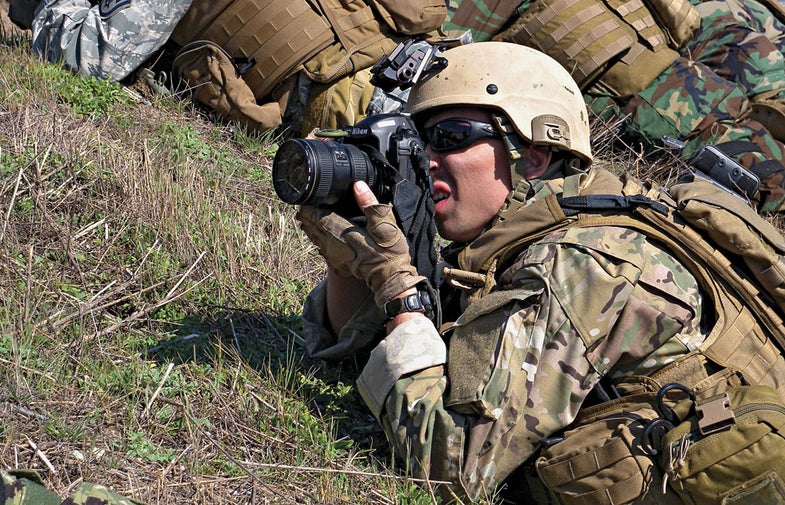
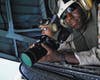
Mass Communication Specialist 2nd Class Derek Sanchez takes photos during Winter Quick Shot 2011 in February 2011 in Azusa, CA.

Lessons in the Field
The production tent, as it’s called, doubles as a classroom where Jones and his other instructors conduct postmortems of each day’s exercises, highlighting useful results and discussing improvements for the unusable ones.
For example, it’s an easy mistake to beam a flashlight directly at a notebook, map, or other object, overexposing the center of the photo to the point of illegibility. The proper technique? Angle the flashlight so the focus spot of the beam does not obscure anything important, feathering the light so it’s bright yet diffuse.
Other lessons involve proper techniques for using cameras in conjunction with night-vision gear. Simple but potentially serious errors include failing to turn off the camera’s autofocus-assist lamp, which can overwhelm night-vision users with brightness and reveal the unit’s position to the enemy. Cameras with night-vision lenses lack AF systems—they focus manually. And setting exposure for night-vision cameras can be tricky.
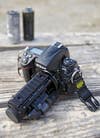
Besides being rigged up to shoot in the dark, the cameras and other photo gear must be rugged enough for the demands of military use. “We buy one or two of the top cameras and take them with our regular gear to an exercise to see how they stand up,” says Jones. “The life cycle of a good one might be 18 to 24 months.” Others last as little as 6 months.
The Navy has long used Nikon cameras and lenses—it owns a lot of Nikon glass. Given their rough treatment, the Nikon D90, D700, and D3S bodies lying around the production tent would fare poorly in the used-camera market.
In Theater
A variety of customers make use of the imagery that Navy Combat Camera units produce. Requests typically come from either the Pentagon, Defense Imagery Management Operations Center (a clearinghouse for all unclassified U.S. military imagery), or battle commanders in the field. Mission assignments range from civil affairs such as disaster relief, to evidentiary support (forensic photography in the field), to operations with Special Forces.
It wasn’t always this way. The U.S. Navy created its Combat Camera unit during the Korean War in 1951, and Navy photographers documented just about everything this branch of the armed services did—and kept doing so through the Vietnam War.
But things quieted down until 2002, and by then a lot of the institutional combat-photography knowledge was lost. Photographers were still employed by the military, primarily for news and public relations, but they almost never encountered hostile forces.
Then, a decade ago, as the U.S. became involved in Afghanistan and Iraq, the rapidly growing need for timely visual information coincided with the rise of inexpensive digital cameras. Now the military had a new means of capturing and delivering media from the front lines. And because it offered new and more ways to document events, digital war photography found more ways to be used.