Pintail Hokkaido Japan
“It’s tough to get close to birds here in the UK — without that ability, being creative can be more challenging. But in Hokkaido Japan, normally shy species, such as Pintail, are very tame which opens up all sorts of creative possibilities. I am always looking to shoot familiar subjects in new ways. For this image I set up a boom pole with my camera and 20mm lens attached over a hole in the ice where ducks were congregating then waited while they got used to the camera above them. Once relaxed, I was able to lower the camera and fire the shutter using a remote.” Shot using a Nikon D3 with 20mm lens at ISO 640, f/8 at 1/500 sec using a boom pole and fired using a Pocket Wizard.
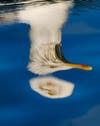
Herring Gull Norway
“I’ve never been the kind of bird photographer that felt compelled to produce simply nice portraits of birds, they turn me off, and so I tend to concentrate on trying to be as “arty” as possible. Reflections are always fun to shoot and while waiting for a White-tailed Eagle to appear in Norway I noticed this reflection of a Herring Gull, made more interesting by the double image from ripples in the water.” Shot using a Nikon D2X with a 300mm f/2.8 lens at ISO 100, f/6.3 at 1/640 sec, hand-held.
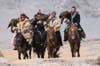
Kazakh Eagle hunters Western Mongolia
“I am currently working on a book in conjunction with Random House Publishers with author Mark Cocker. The book is called ‘Birds and People’, in it, we are exploring the cultural links to birds worldwide. The project has taken us across the world shooting images of both amazing birds but disappearing cultures too. One of the highlights was time spent with nomadic Kazakhs in a remote region of Mongolia where they still hunt with Golden Eagles.” Shot with a Nikon D300 and a 300mm f/2.8 lens at ISO 200, f/6.3 at 1/1000 sec, hand-held.
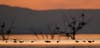
Waders on the Salton Sea California
“I made a road trip across California a couple of years ago arriving at the Salton Sea late one evening. This was the first image I made, an attempt to try and give a sense of place to the birds that flock to the sea to feed and breed. I laid at the waters edge to try and create more of an intimate feel to being on the birds level.” Shot with a Nikon D300 with 500mm f/4 lens at ISO 250, /f4 at 1/320 sec, with lens resting on ground.
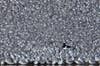
Oystercatcher among Knot Norfolk UK
“One of Europe’e finest bird spectacles occurs not far from my home each autumn and winter when tens of thousands of Knot, a wader that breeds in the Arctic, descend on the vast mudflats of the Wash in Norfolk. On big high tides thousands of them crowd on to small islands on a lake just behind the sea wall which is overlooked by public blinds. Great photographic opportunities can be had as thousands of birds stand shoulder to shoulder. On this occasion a brightly colored Oystercatcher landed among the Knot giving a splash of color. I off-centered the Oystercatcher to help lead the viewers eye into the picture.” Shot with a Nikon D300 and a 300mm f/2.8 lens plus a 1.7 x teleconverter (35 mm equivalent incl 1.7 x teleconverter = 900 mm) at ISO 250, f/8 at 1/320 sec.
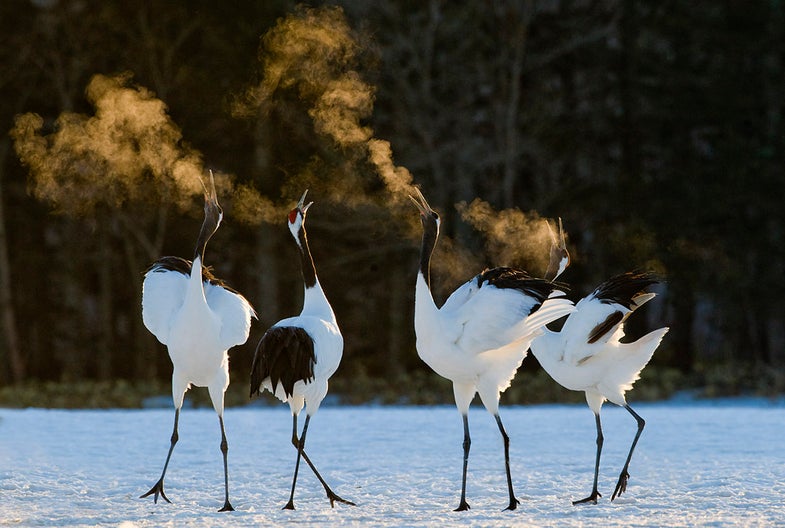
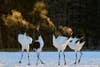
Japanese Cranes displaying at dawn Hokkaido Japan
“Occasionally everything comes together to be able to capture a special image and this is what happened here. These two pairs of cranes came together and trumpeted just as the sun rose above the horizon, lighting beautifully their breath against the trees in heavy shadow behind. To make this image the temperature needed to be low too and it was at minus 20 degrees Celcius.” Shot using a Nikon D3 and a 500mm f/4 lens mounted _on a Gitzo tripod with a Dietmar Nil head at ISO 800, f/4 at 1/640 sec._
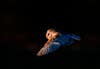
Barn Owl Norfolk UK
“I am lucky to live in an area where Barn Owls are not uncommon, and interestingly for a normally nocturnal species, they often hunt here in Norfolk during the day. This image was taken just as the sun was sinking away over the horizon. The owl was hunting along a hedge that was in heavy shadow and the bird kept flying through “pools of light” as shown here. I manually meter and so I had everything set up to correctly expose the bird in sunlight. Had I been on Auto, such a scene could easily have fooled my camera’s exposure meter, ending up with the owls white plumage being blown out.” Shot with a Nikon D300 using a 500mm f/4 lens at ISO 250, f/5 at 1/500 sec, hand-held.
Black Grouse Finland
“Abstract images that work are always a challenge, the need for making something abstract enough to make the viewer stare and become engaged with the image, but not too abstract so that you can’t tell what is going on, is a hard line to travel. But I feel this is one of my more successful ones. Black Grouse have beautiful lyre shaped tails and during spring congregate at leks where they display to visiting females. Pumped up like teenagers showing off to a beautiful girl at a disco, they can get into combat with their neighbors. I wanted to illustrate the tail but also give a sense of place illustrating the bird on his lek, so I focused with a shallow depth of field on the tail making sure no other male was in the frame.” Shot with a Nikon D300 and 300mm f/2.8 lens (35 mm equivalent = 450 mm) at ISO 250, f/2.8 at 1/1000 sec, hand-held.
Snow Geese & Sandhill Cranes Bosque del Apache New Mexico
“Bosque del Apache in New Mexico has become a popular destination for European wildlife photographers to visit in winter. Often beautiful light and tame birds in abundance create great opportunities. This image was taken at sunrise during those magical 2-3 minutes when the first shafts of sunlight spill across the land. After a cold night, steam rose from the water on which the birds roosted, creating this ethereal atmosphere. For this image I shot directly into the rising sun and to avoid lens flare, I taped a bit of cardboard over the top half of my lens hood to stop extraneous light from spoiling the image. I used a large depth of field to give depth to the picture and accentuate the atmosphere of birds crowded together among rising steam.” Shot with a Nikon D300 and a 500mm f/4 lens at ISO 250, f/18 at 1/125 sec, mounted on a Gitzo tripod with a Dietmar Nil head.
Eider surfing waves Northern England
“In the county of Northumberland in northern England there are a few locations along the coast where Eider ducks flock together in winter. I wore chest waders and joined the birds in the surf to capture this image of a male Eider breaking through a wave. I stayed low to help portray the drama of the moment and used a very fast shutter speed to ensure the action was frozen. I purposely placed the bird towards the top left of the frame to allow the eye to wander along the wave to the bird, and to help illustrate the wave the bird was swimming through.” Shot using a Kodak DSC Pro N and a 500mm f/4 lens with 1.4 x converter at ISO 160, f/8 at 1/1500 sec, hand-held.