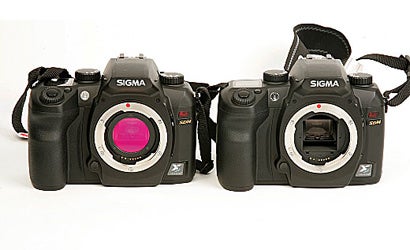
One of the easiest and coolest camera hacks we've seen lately is possible with the just-released Sigma SD14. And best of all, it doesn't involve specialized tools, major camera dissection, or any potential warranty voiding actions.
By simply removing the infrared (IR) cutoff filter from this digital SLR, the camera gains the ability to capture IR plus visible spectrum images. And with the addition of an IR filter, you can go straight to IR-only capture.
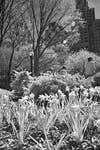
Why would anyone want to do this? Foliage and water can have dramatic shifts when captured in infrared, and make for impressive IR monochromes. As seen by the photos in this gallery, IR imaging can bring out cloud details in an overcast sky or make a building in the background sharp despite atmospheric haze. IR imaging brings to light a world that's hidden just beyond the edges of our vision.
OK, but is this really that easy?
In a word, yes. The reason the IR filter is so easy to remove on the SD14 is to allow the owner to clean their own sensor. This manufacturing choice is an awesome side effect that makes the SD14 one of the few, if not only, hot-swappable IR/visible spectrum SLRs available. Unlike with most other SLRs, which have the IR cutoff just in front of the chip, the IR cutoff filter of the SD14 sits in front of the reflex mirror, and it's a simple process to pop it out. We highly recommend wearing lint-free cotton gloves while removing it to reduce the risk of getting a greasy thumbprint in the middle of the glass for when you re-install it.
Once it's out, you're all set for IR plus visible spectrum photography. We suggest shooting RAW, because even though RAW on the SD14 is ridiculously sluggish, you'll gain much more processing power and exposure latitude when using either Adobe Camera RAW or Sigma's Photo Pro software -- and you'll need to do some major global tweaks to get the images looking good.
Add an IR-exclusive filter, and you'll limit your exposure to IR-only. For these experiments, we used a Cokin 89B filter because that's what we had handy. It transmits at 720nm, but an 87C or other IR-only filter will also do the trick.
IR plus visible and IR-only are two completely different shooting experiences. For IR plus visible, you can frame through the viewfinder. But with IR-only, there's virtually nothing to be seen. Ultra-bright hotspots may bleed through ever-so-slightly, but for the most part it's totally blind shooting. To ensure sharp photos with the Sigma 17-70mm kit lens, we chose hyperfocal distance and stopped down to f/10 to cheese enough depth of field to get almost everything in the frame acceptably sharp.
As with the Fuji UVIR, framing in IR-only mode was accomplished via the ultra-scientific "other eye" method -- hold the camera up to your eye, as if you could see through the IR filter, and frame it with your other eye.
In both IR-plus and IR-only, we found that we were getting the best results at about 2-3 stops underexposure, based on in-camera metering. We found that f/10 1/100 ISO 100 was a good starting point for daytime exposures. You'll probably want to chimp your histograms and also bracket your exposures until you get a feel for it. The LCD preview is going to show a ton of red, but don't worry. Messing around in RAW processing will get them looking good.