Camera Test: Canon EOS-1D X
The Canon EOS-1D X is an ideal DSLR for sports shooters
We may earn revenue from the products available on this page and participate in affiliate programs. Learn more ›
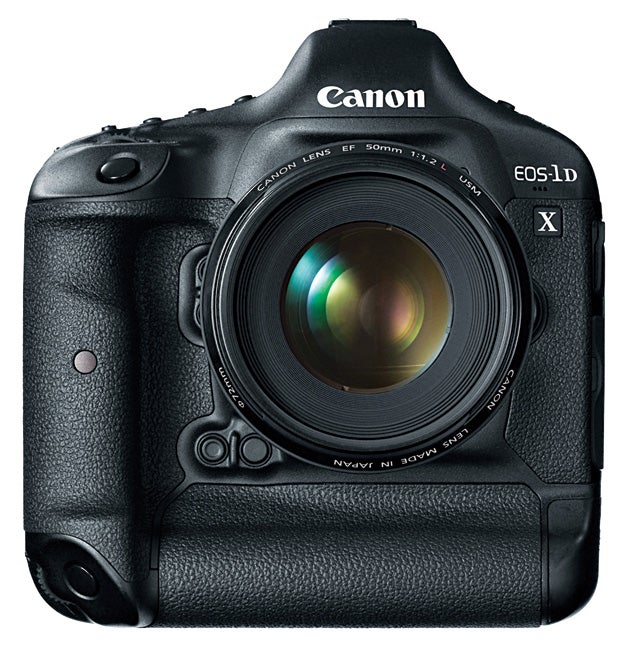
Canon doesn’t refresh its EOS-1D line very often. This time, the world had to wait even longer than usual due to the tragedy of the 2011 Tohoku earthquake, the crushing tsunami it generated, and the (unrelated) flooding that rocked Thailand. And so the 18.1MP Canon EOS-1D X ($6,799, street, body only), announced back in October 2011, became available to retail buyers only in July of this year.
And, in a fairly radical move, Canon has also consolidated its burst-centric 1D series and studio-shooter’s 1Ds series into a single tough, speedy camera body meant to address the needs of both of these groups of professional photographers. With that consolidation, the 1D X has new metering and AF systems, a new CMOS sensor, and full HD video recording capabilities. All of this (and more) is housed in a super-rugged magnesium-alloy body made to withstand the most brutal conditions to which a camera can be subjected, short of serious injury to the photographer.
And we can now finally report on how the 1D X fared in the Popular Photography Test Lab.
In the Test Lab
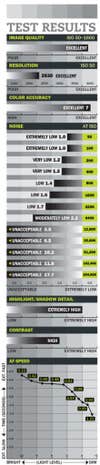
With a beguilingly film-like look to its images and lab numbers to back them up, the EOS-1D X earned an overall Image Quality rating of Excellent from its lowest sensitivity of ISO 50 through ISO 1600. That’s a couple of stops fewer than the EOS 5D Mark III earned with its Excellent rating from ISO 50 through 12,800.
More interestingly, it is one stop better than the Nikon D4 fared when we tested it in our June 2012 issue, although the results for Canon and Nikon’s top-of-the-line DSLRs were even closer than the overall ratings suggest. In our resolution test, the 1D X tied the D4 exactly at ISO 50 with 2530 lines per picture height. The D4 fell to 2490 lines at ISO 1600, thus disqualifying it for Excellent status, while the 1D X barely held on to that honor with 2510 lines.
By ISO 3200, the 1D X dropped to 2490 lines, which it maintained at ISO 6400, as well. The two cameras repeatedly swap pole position up the sensitivity scale until the pinnacle, ISO 204,800, where they nearly matched—the D4 with 1810 lines and the 1D X with 1800 lines. For perspective, typical observers likely won’t notice that narrow a difference in resolution in real-world images. It’s essentially a tie in resolving power.
In our noise test, the Canon beat the Nikon at their lowest three ISOs, tied in the middle of their ISO range, and fell behind the Nikon a bit once both cameras reach Unacceptable territory at ISO 12,800. The exception to this is at ISO 204,800, where both showed tremendous noise, though the Canon not quite as much as the Nikon.
It should come as no surprise that the 1D X easily managed an Excellent rating in our color accuracy test, with an average Delta E of 7.0. In another note of synchronicity, the D4 yielded exactly the same result.
Our autofocus test showed very fast results for Canon’s new flagship. At the brightest light level in our test (EV 12), the 1D X focused in 0.33 second. Nikon’s D4 proved slightly faster in the brighter part of our test, but gained ground as we set the lamplight lower. From EV 2 down to our dimmest level of EV –2, the D4 proved consistently at least 0.1 second faster than the 1D X; at the moonlight-like level of EV 1, the Canon focused in 0.84 second, compared with 0.63 second for its Nikon rival.
In the Field
Built on the backbone of a strong magnesium-alloy body, the 1D X includes Canon’s highest level of weathersealing and boasts a newly redesigned 400,000-cycle shutter with carbon-fiber blades. This thing is built to last.
Plus, it’s built for speed. Those lightweight shutter-curtain blades, along with other design wizardry, lets the 1D X achieve a top burst rate (without continuous metering or autofocusing) of 14 JPEG frames per second. Canon rightly calls that Super High Speed burst mode. The camera locks the mirror up, and in live-view mode blanks out the screen, during the burst. So precision applications are limited.
Still, we had plenty of fun in this mode when we preset exposure and focus using a Lensbaby Composer with Sweet 35 optic, and shot slightly blind, as if the 1D X were a half-speed Bolex home-movie camera with no finder. With enough depth of field, you could create a striking sequence of shots from, say, a runner crossing a finish line as the ribbon breaks away and wraps around her.
The 1D X’s top regular burst speed is a still-stunning 12 fps for up to 180 JPEGs, 38 RAW, or 17 RAW + JPEG shots when using a UDMA mode 7 CF card. By way of comparison, Nikon’s D4 tops out at 10 fps and promises up to 170 JPEGs, but it can capture up to 69 RAW images in a burst. That’s quite a difference, and it could be enough for photographers who rely on burst shooting in RAW to opt for the Nikon.
The Canon, like its rival, does an exemplary job of tracking AF. As in the 5D Mark III, the 1D X has five pages of its menus dedicated to AF alone. You can tell the camera ahead of time if you know that a subject you want to track will enter the frame from a particular side, or tell it to ignore objects that pass in front of the subject you’re tracking. This can be very useful when panning along with a subject.
Another setting is dedicated to subjects that accelerate or decelerate quickly. If autofocus wasn’t complicated enough for you before, run out and buy the 1D X immediately.
If you don’t like to dig through menus while you shoot, you’ll love all the customizable controls on the 1D X’s body. You can assign custom functions to 11 different buttons, dials, or joysticks, five of which are duplicated for a seamless transition between portrait and landscape orientation. A custom controls menu accessed through the quick menu offers a diagram of the camera to help you keep track of all of those controls as you assign them.
This level of customization is key to a camera of this level. It, along with ruggedness and a top-level imaging engine, are why you’d shell out the big bucks for a body like the 1D X, and Canon definitely delivers on all of these fronts.
It also delivers on ergonomics. While small-handed users will probably prefer the generously sculpted grips of Nikon and Sony models, Canon did introduce a slight inward angle to the inside portion of the 1D X grip that makes it feel more secure than some of its older pro bodies.
The angle of the shutter button has also been changed ever so slightly, such that it is actually easier to press than the one in the EOS-1D Mark IV. The company says that this was done to combat repetitive motion issues, and we’re sure that pro Canon shooters will be grateful. We also appreciated the responsiveness and texture of the new joystick buttons, a delight to use.
Another luxury of a 1D-level camera: the viewfinder. A 100% accurate, bright pentaprism finder lets you frame images with precision. Until you’ve used a perfectly accurate finder like this one, you’ll never appreciate the ability to use the entire 35mm image frame to tell your story. And once you have, you may never want to go back to a cropped finder. As with any piece of photo gear, the more options at your disposal, and the more control you can exert over the image, the wider your vocabulary as a photographer can become. In this sense, the 1D X is like an unabridged dictionary.
Videographers will find a choice of intra-frame ALL-I or inter-frame IPB compression. The former maintains the integrity of each frame of the video and compresses them separately so that you can extract a single frame without trouble. The latter has a much better compression ratio, resulting in smaller files, but uses key frames and the differences from them to pack up the data. This makes it harder to pull out one frame at a time.
Both of these capture choices yield extremely high-quality video. But Nikon’s D4 one-ups Canon a bit here by offering an uncompressed video stream from its HDMI port that can be sent to an external recorder.
If you’re extremely serious about shooting video (which might raise the question of why you’re looking for a DSLR in the first place instead of one of Canon’s EOS Cinema cameras), this may make a difference to you. But if you’re essentially a still shooter looking to add video to your repertoire, the 1D X will deliver all you need.
The Bottom Line
Canon has yet again created a truly amazing camera with the EOS-1D X. From the first weekend we got to shoot with it, when we came home with a dozen keepers, up until the last frame we shot for this test, it was simply a pleasure to use.
We’ve touched on the most important parts, but there’s also Ethernet connectivity, a stereo mic input, and plenty of other features, such as multiple-exposure capability and audio note taking, that we just couldn’t go into detail about here.
Suffice to say that the 1D X is every bit the imaging powerhouse that all 1D-series cameras have been in their time.
Evidence of just how right Canon got the 1D X is how well it stacks up to Nikon’s excellent D4. While some years have led us to rank one Canon or Nikon supercamera over the other, in this case the two are so evenly matched that we can’t declare a clear winner.
Photographers who are entrenched in either system, of course, should just trust the glass and accessories they’ve got, and upgrade to the new models as they see fit. But anyone looking to enter a system at this level will have a tough choice. If you’re a dedicated video shooter, you might pick the D4. If you feel you need faster bursts than 10 fps, then clearly the 1D X would be your gun. Otherwise, you might consult a flipping quarter—you’ll win, whatever side comes up.
SPECIFICATIONS
IMAGING: 18.1MP effective, full-frame CMOS sensor captures images at 5184×3456 pixels with 14 bits/color in RAW mode.
STORAGE: Dual CF slots store JPEG, CR2 RAW, and RAW + JPEG files.
BURST RATE: Full-sized JPEGs (Fine mode), up to 180 shots at 12 fps; RAW (14-bit), up to 38 shots at 12 fps; RAW+JPEG, up to 17 shots at 12 fps. using a UDMA mode 7 card.
AF SYSTEM: TTL phase detection with 61 selectable focus points (41 cross-type); single-shot and continuous AF with predictive focus tracking. Tested sensitivity down to EV –2 (at ISO 100, f/1.4).
LIVE VIEW: TTL phase-detection or contrast-detection autofocus.
SHUTTER SPEEDS: 1/8000 to 30 sec, plus B (1/3-, or 1-EV increments); 400,000-cycle rating.
METERING: 252-zone TTL metering with 100,000-pixel RGB sensor; evaluative, centerweighted, partial (approx. 6.5% of viewfinder) and spot (approx. 2.5% of viewfinder). EV 0–20 (ISO 100).
ISO RANGE: Normal, ISO 100–51,200 (in 1/3-EV increments); expanded, ISO 50–204,800.
VIDEO: Records at 1920×1080 at up to 30 fps; 1280×720 at up to 60 fps; in H.264 MPEG-4 MOV format with selectable IPB or ALL-I compression; built-in mono microphone; stereo minijack input; maximum clip length: 29min. 59 sec.
FLASH: No built-in pop-up. Hot shoe with E-TTL II autoflash; flash sync to 1/250 sec.
VIEWFINDER: Fixed eye-level pentaprism.
LCD: 3.2-in. TFT with 1,040,000-dot resolution; 7-step brightness adjustment.
OUTPUT: USB 2.0, mini HDMI video, Ethernet up to 1000BASE-T, composite video and analog audio.
BATTERY: Rechargeable LP-E4N/LP-E4 Li-ion, CIPA rating 1120 shots (with optical viewfinder); 290 shots (with live view).
SIZE/WEIGHT: 6.2×6.4×3.3 in., 3.4 lb with a card and battery.
STREET PRICE: $6,799, body only.
INFO: www.canoneos.com
VIEWFINDER TEST: Accuracy, 100% (Excellent); Magnification, 0.7X (Very Good).