With a massive 10.7X range that reaches supertele on DSLRs with APS-C-sized sensors, full-frame 28–300mm zooms handle nearly every photo genre: wildlife, portraits, landscapes, even close-ups. The category runs from Canon’s f/3.5–5.6L ($2,420, street) to Sigma’s f/3.5–6.3 ($300, street). Between the extremes lie Tamron’s f/3.5–5.6 ($600, street) and now this Nikon f/3.5–5.6 ($1,030, street). Yet despite the wide variation in price, features, and build, all these current models turned in fairly similar optical performances in our Test Lab.
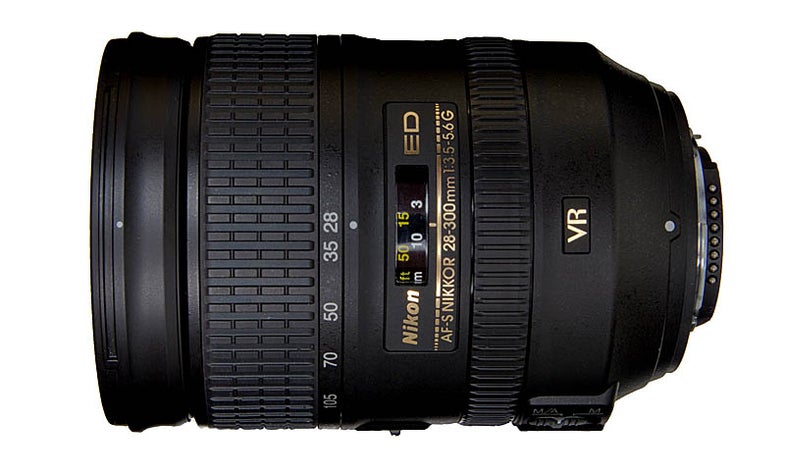
This Nikkor has two ED and three aspheric elements, second-generation Vibration Reduction, Nikon’s truly silent SWF AF motor, and a zoom lock. A 42–450mm equivalent on DX bodies, it also has an internal-focusing design with a nonrotating barrel and manual-focus capability in the AF mode.
It’s compact when retracted and not too heavy—less than half the weight of the Canon. But it extends to nearly 10 inches at 300mm (with the supplied hood in place). Well finished and marked, with smooth-turning zoom and focusing rings, it has an AF action that’s fast and outstandingly quiet.
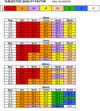
On our optical bench, it produced superior sharpness and contrast at three of four tested focal lengths, but SQF dropped to the Good range at 300mm. (All 28–300mm full-framers performed similarly, except Tamron’s, which dipped to Very Good at 200mm.)
In DxO Analyzer 3.2 tests, the Nikon showed Visible distortion at all tested focal lengths, comparable to the Tamron and significantly better than the Canon’s Very Visible barreling at 28mm. It excelled in edge falloff and macro—at 300mm, top in this class on falloff. The VR II also fared well, delivering 1–3.5 extra stops of handheld shooting for three users.
A paragon of the breed, Nikon’s latest all-in-one zoom offers benefits for every type of photographer.
Should this replace the nikkor 24-70 f/2.8 on my D700 now because it has a wider range? With low lighting obviously the 24-70 would excel, but would the 28-300 be better in daylight and good lighting situation?
The 28-300 3.5 VRII is my constant companion "walk around" lens. It offers tremendous range in photographing small wildlife from a desert garden area, ie. hummingbirds, other birds and occasional critters. The versatility is useful for portrait and small group photography. Lightweight and relatively fast focus allows for quick action. I cannont recommend it enough...and do so to all of my friends!
Above comment was submitted by me. Visit my FB photography page to see many photos from this lens.
This chart proves my point even further. Notice that the maximum aperture possible with this lens at even 70mm is f/5.0. And at 200mm and beyond it is 5.6. The light weight of this lens is a good thing, but the maximum aperture compromises even at 70mm are not worth it to me. I think I would feel that my image possibilities would be suffering often when using this lens. The lower quality marks at high magnifications (like 16X20 and larger, especially at 200mm and longer focal lengths, would also include any images you shoot and later crop before enlarging - even if you are enlarging to 8X10 or 11X14. I always love Nikon cameras and lenses and really want this one to be great. Unfortunately I think it will be enjoyed most by shooters who do not have a discerning eye when critiquing their images.
My personal opinion is that these lenses (by Nikon, Sigma, Canon & Tamron) that include such a wide focal length range cannot excel at any of them. I am a loyal Nikon user - since the beginning of my career - and would love to have one lens that would cover the demands of every assignment. However, the 5.6 maximum aperture allowed by this Nikon lens at longer focal lengths alone compromises what I often need when hand holding a lens. I use a D700 also and have been satisfied with many images up to ISO 3200 (when shooting indoors or in low light outdoors), but this lens compromises your images too much unless most or all of your shooting is in bright outdoor light. A friend asked me about this lens when it first came out, and I was excited to learn about it because it is designed for FX sensor Nikon cameras. The tests reveal image compromises at most focal lengths, which I translate as inferior photos compared with other lenses available that do not cover such a wide focal range. My recommendation, until/unless a lens superior to this one is manufactured, is to use at least two different lenses to cover the 28-300mm spectrum and - if affordable for you - buy lenses (like your 24-70mm) that have one wide f stop (f/2.8 or 4, for example) across the entire zoom range, so that the exposure remains constant regardless of the focal length setting. You will likely be much more satisfied with ALL of your images, especially with a spectacular camera like the Nikon D700. At this time I don't believe there is ONE lens available for any DSLR that can achieve excellent results at all focal lengths between 28 and 300mm. It would be nice though.
$1,000???? Who are they kidding? This is not a "pro" lens. As several have pointed out, at 5.6 this is not a fast lens. Yes it has a great range but at what cost? If all you're after is a range of focal lengths, you can buy a 28-200 for $150!!!! I don't find a great assist from the VR and do not feel it justifies the extra expense.
I do have a discerning eye and this lens is on my D300s much of the time. Tack sharp images, even when cropped. I love it and would replace it in a minute if I had to. Buy it!
For molardaddy: No, it doesn't even come close to replacing a 24-70 f/2.8. If you can handle the loss of one stop and get vr instead, the new 24-120 might do that. This baby is a swiss army knife lens; jack of all trades/master of none. That said, it's a terrific vacation/good light sports lens for an FX body (I even use it on DX), paired with a 16-35 on FX or a 10-24 on DX it makes a great 2 lens walkaround combo.
Should this replace the nikkor 24-70 f/2.8 on my D700 now because it has a wider range? With low lighting obviously the 24-70 would excel, but would the 28-300 be better in daylight and good lighting situation?
The 28-300 3.5 VRII is my constant companion "walk around" lens. It offers tremendous range in photographing small wildlife from a desert garden area, ie. hummingbirds, other birds and occasional critters. The versatility is useful for portrait and small group photography. Lightweight and relatively fast focus allows for quick action. I cannont recommend it enough...and do so to all of my friends!
Above comment was submitted by me. Visit my FB photography page to see many photos from this lens.
This chart proves my point even further. Notice that the maximum aperture possible with this lens at even 70mm is f/5.0. And at 200mm and beyond it is 5.6. The light weight of this lens is a good thing, but the maximum aperture compromises even at 70mm are not worth it to me. I think I would feel that my image possibilities would be suffering often when using this lens. The lower quality marks at high magnifications (like 16X20 and larger, especially at 200mm and longer focal lengths, would also include any images you shoot and later crop before enlarging - even if you are enlarging to 8X10 or 11X14. I always love Nikon cameras and lenses and really want this one to be great. Unfortunately I think it will be enjoyed most by shooters who do not have a discerning eye when critiquing their images.
My personal opinion is that these lenses (by Nikon, Sigma, Canon & Tamron) that include such a wide focal length range cannot excel at any of them. I am a loyal Nikon user - since the beginning of my career - and would love to have one lens that would cover the demands of every assignment. However, the 5.6 maximum aperture allowed by this Nikon lens at longer focal lengths alone compromises what I often need when hand holding a lens. I use a D700 also and have been satisfied with many images up to ISO 3200 (when shooting indoors or in low light outdoors), but this lens compromises your images too much unless most or all of your shooting is in bright outdoor light. A friend asked me about this lens when it first came out, and I was excited to learn about it because it is designed for FX sensor Nikon cameras. The tests reveal image compromises at most focal lengths, which I translate as inferior photos compared with other lenses available that do not cover such a wide focal range. My recommendation, until/unless a lens superior to this one is manufactured, is to use at least two different lenses to cover the 28-300mm spectrum and - if affordable for you - buy lenses (like your 24-70mm) that have one wide f stop (f/2.8 or 4, for example) across the entire zoom range, so that the exposure remains constant regardless of the focal length setting. You will likely be much more satisfied with ALL of your images, especially with a spectacular camera like the Nikon D700. At this time I don't believe there is ONE lens available for any DSLR that can achieve excellent results at all focal lengths between 28 and 300mm. It would be nice though.
$1,000???? Who are they kidding? This is not a "pro" lens. As several have pointed out, at 5.6 this is not a fast lens. Yes it has a great range but at what cost? If all you're after is a range of focal lengths, you can buy a 28-200 for $150!!!! I don't find a great assist from the VR and do not feel it justifies the extra expense.
I do have a discerning eye and this lens is on my D300s much of the time. Tack sharp images, even when cropped. I love it and would replace it in a minute if I had to. Buy it!
For molardaddy: No, it doesn't even come close to replacing a 24-70 f/2.8. If you can handle the loss of one stop and get vr instead, the new 24-120 might do that. This baby is a swiss army knife lens; jack of all trades/master of none. That said, it's a terrific vacation/good light sports lens for an FX body (I even use it on DX), paired with a 16-35 on FX or a 10-24 on DX it makes a great 2 lens walkaround combo.