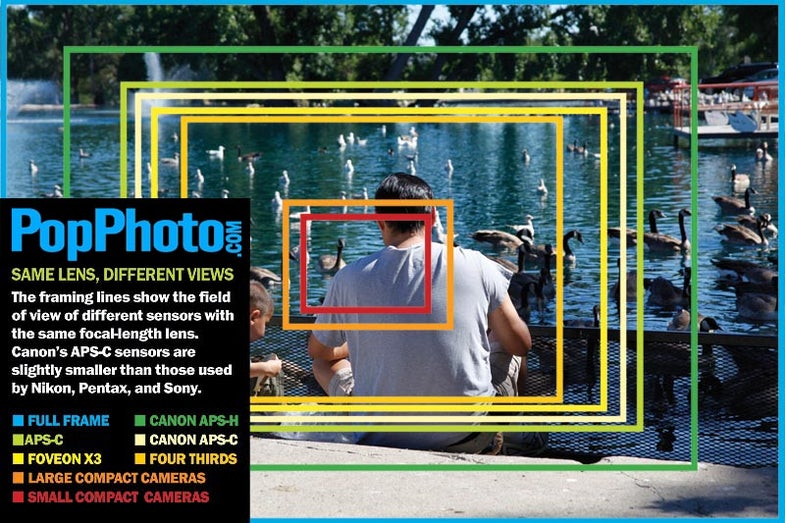
Imagine putting the same focal-length lens on eight different kinds of cameras. Position each camera in the exact same place, at the same height, aimed at exactly the same spot. Would the pictures from each camera show the same scene?
Not if they used sensors with different physical dimensions. Depending on the size of the sensor, from a full-frame DSLR down to a pocket compact (we didn’t bother with cell phones), you would get the progressively smaller framings superimposed on the photo at left. Why? As the sensors get smaller, they take in less of the image projected onto them by the lens, as shown in the diagram above.
For this reason, the photo industry has adopted equivalencies to relate all these different angles of view to a single reference standard: the 35mm film frame, whose dimensions of 24x36mm are also those of the full-frame digital sensor.
Our photo was taken with a full-frame Canon DSLR with a zoom at 85mm; a Canon APS-C DSLR at the same focal length would provide the full-frame equivalent of about a 135mm lens.
You can use a multiplier called lens factor or crop factor to determine equivalencies—particularly convenient for interchangeable-lens systems. Multiply the stated focal length of your lens by these figures to get the full-frame equivalent: APS-H (now, just the Canon EOS-1D Mark IV), it's 1.3X; for non-Canon APS-C, 1.5X; Canon APS-C, 1.6X; Sigma’s Foveon sensors, 1.7X, and Four Thirds, 2X.
So, with smaller and smaller sensors, you need progressively wider-angle lenses to maintain the full-frame equivalent.
Confusing? A better way would be to state the angle of view lenses project on a given format, which would require no translation into an “equivalent.” An ultrawide would give you a greater than 85-degree angle of view; a “normal” lens, around 40 degrees. Superteles would be those that give you single-digit angles of view. Unfortunately, nobody describes them that way.
okay for perspective, but depth-of-field goes with the lens. Normal 50mm depth-of-field for a 35mm film camera isn't the same as Normal 25mm on a 4/3s Olympus.
I favor standardizing on the horizontal and vertical angles of view. The Wikipedia explains how to perform the calculation. The results can be displayed as a table on the back of a business card.
Regarding Domke's comment, perspective is determined by the position of the camera relative to the position of the subject being photographed, not by the angle of view of the lens.
For an excellent explanation of depth of field, see "The Depth-of-Field Myth and Digital Camera" at .
at clarkvision-dot-com.
To narrow my point, the "Crop Factor" I uses EOS Rebel T2i, reading the 'crop factor article'. My Rebel T2i is a APS-C 1.6x Sensor 22.3 x 14.9 mm Pixel Size 4.3um Pixel/Megapixels 5184 x 3456 18.0 ViewFinder-.87x 95% the DLA f/6.8 Diffraction Limited Aperture. Which the depicted Frame line shows the fifth frame Angle of View at 1.6x (22.5mm x 15mm).- The term Field of View Crop Factor has come into our world. The source of this term is based on the fact that the smaller-than-35mm Sensors present in many of Canon and other manufactures' DSLR sensors, but sensors smaller than 35mm sensors do not capture the entire image, thus, the image is "Cropped". The Field of View Crop Factor (FOVCF) x Focal Length Mutipler is a not-exactly-correct-best-helpful term that many photographers' like to use to describe the Field of View Crop Factor as well as compensate the subject framing is significantly different between the various FOVCF DSLRs when using the same focal length lens and the same subject distance. More to learn?.
Its one of my favorite post. Its also helpaful topic for newbie. Thanks a lot for informative information.Homes
Great accumulating of advantageous links, accoutrement and resources. Thanks for the astern nights and assimilation in adequate others.
okay for perspective, but depth-of-field goes with the lens. Normal 50mm depth-of-field for a 35mm film camera isn't the same as Normal 25mm on a 4/3s Olympus.
I favor standardizing on the horizontal and vertical angles of view. The Wikipedia explains how to perform the calculation. The results can be displayed as a table on the back of a business card.
Regarding Domke's comment, perspective is determined by the position of the camera relative to the position of the subject being photographed, not by the angle of view of the lens.
For an excellent explanation of depth of field, see "The Depth-of-Field Myth and Digital Camera" at .
at clarkvision-dot-com.
To narrow my point, the "Crop Factor" I uses EOS Rebel T2i, reading the 'crop factor article'. My Rebel T2i is a APS-C 1.6x Sensor 22.3 x 14.9 mm Pixel Size 4.3um Pixel/Megapixels 5184 x 3456 18.0 ViewFinder-.87x 95% the DLA f/6.8 Diffraction Limited Aperture. Which the depicted Frame line shows the fifth frame Angle of View at 1.6x (22.5mm x 15mm).- The term Field of View Crop Factor has come into our world. The source of this term is based on the fact that the smaller-than-35mm Sensors present in many of Canon and other manufactures' DSLR sensors, but sensors smaller than 35mm sensors do not capture the entire image, thus, the image is "Cropped". The Field of View Crop Factor (FOVCF) x Focal Length Mutipler is a not-exactly-correct-best-helpful term that many photographers' like to use to describe the Field of View Crop Factor as well as compensate the subject framing is significantly different between the various FOVCF DSLRs when using the same focal length lens and the same subject distance. More to learn?.
Its one of my favorite post. Its also helpaful topic for newbie. Thanks a lot for informative information.Homes
Great accumulating of advantageous links, accoutrement and resources. Thanks for the astern nights and assimilation in adequate others.