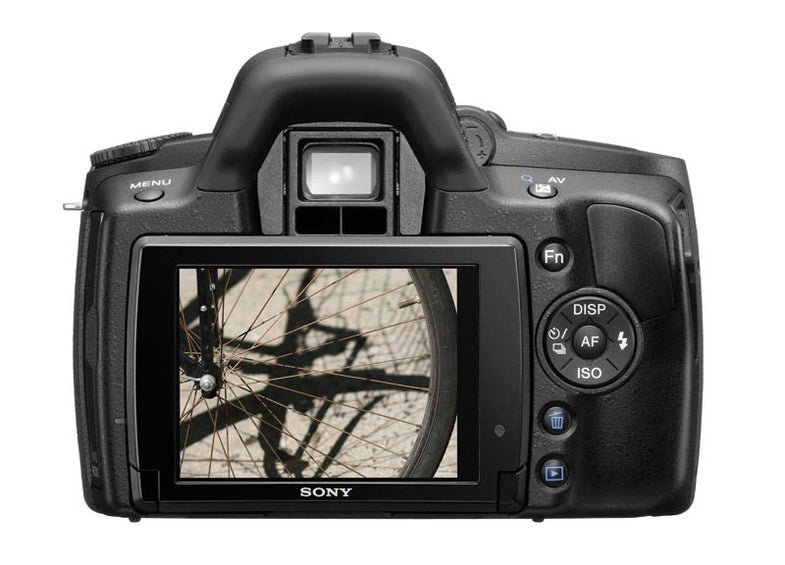
The more grippable successor to the A380 is a lot like, well, the A380.
When we tested Sony’s Alpha 380 last year, we hated the grip and noted that its 14.2MP sensor could’ve provided more resolving power. Now, Sony has replaced this entry-level model with the new 14.2MP Alpha 390 ($600, street, with 18–55mm f/3.5–5.6 Sony DT SAM lens). It’s extremely similar to its predecessor, but has a completely redesigned grip, a notable improvement over the old one. The rest of it? Well. . .
In the Test Lab
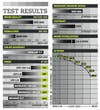
Given that the innards of the A390, by Sony’s admission, don’t differ significantly from the A380, we’re not surprised that the test results from the Popular Photography Test Lab are essentially the same. In our resolution test, the A390 showed 2200 lines per picture height, just behind the A380’s 2255 lines, earning the A390 a Very High rating on our scale— unimpressive for a camera with 14.2 effective megapixels. The Panasonic Lumix DMC-G10 Micro Four Thirds camera, by comparison, scored 2240 lines with a sensor that is smaller in physical size and, at 12.1MP, has 2 million fewer pixels.
In our color accuracy test, the A390 earned an Excellent rating, with its average Delta E of 7.7 from 8-bit TIFFs converted from RAW files using Sony’s Image Data Converter SR. Converting to 16-bit TIFFs improved accuracy a tiny bit, yielding a 7.5—in this test, a lower score being better. Again, this is nearly identical to its predecessor, which scored 7.3 in 8-bit.
The Sony keeps noise at acceptable levels across all its ISOs, although the camera’s top is a modest ISO 3200. Again, the A390 finds itself bested by an ILC, this time Sony’s own NEX-3, which reaches up to ISO 12,800 and showed lower noise numbers at almost all the ISOs the two cameras share. Of course, the NEX-3 lacks an optical viewfinder, which makes the A390 better for panning along with a subject, especially while bursting. Since the A390’s mirror can flip up and down faster than the NEX-3’s LCD can re-establish a preview image, you get more visual feedback from the A390, as you would with any DSLR.
Another point about the A390’s low noise scores is the way it achieves them, namely, through blurring. At ISO 3200, the A390’s resolution drops to 1870 lines—a significant drop, and very noticeable in images shot at that ISO.
In our autofocus test, the A390 proved speedy in bright and moderate light, achieving focus in a scant 0.29 second at the brightest level in our test of EV 12, slowing to a still-impressive 0.48 second in the mid-level EV 6 and slowing to 1.09 second at EV 0, the dimmest level at which the camera was able to focus. While Sony rates the AF system to be effective only down to EV 0, we were surprised that the camera failed to focus in dimmer light, given that the A380 was able to focus down to EV –1 in our test. Despite that limitation, we were quite pleased with the A390’s ability to lock focus quickly in moderate and bright light.