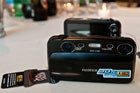
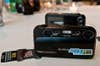
Surrounded by 3DTVs and reconstructed skeletons of prehistoric creatures at New York's Museum of Natural History, last night we spent some hands-on time with Fujifilm's latest 3D compact. Having tried out all of its new features, as well as the ones that have been carried over from last year's Real 3D W1, it's fair to say that this is a big step forward.
The first thing you'll notice when picking the camera up is how compact it is. The elongated body shape makes it easy to fit in a pocket, but also makes it a little unwieldy to hold when shooting. The flush lenses don't extend from the body, and the rightmost optics are extremely close to the shutter button, which means the traditional one-handed grip is pretty much out of the question. Unfortunately, it's also fairly easy to get your index finger in front of the left lens, especially if you have large hands. Expect your fingers to make some cameos in your shots, at least until you've nailed down the perfect position for holding it.

The Screen:
Perhaps the most intriguing part of the whole device is the 3.5-inch parallax barrier LCD 3D screen that doesn't require glasses for the three dimensional experience. We found it to be fairly similar to the screen on the W1, although the W3's display was slightly brighter than we had expected going in. Getting the 3D effect just right is crucial and requires a dead-on viewing angle. Even a couple degrees askew and you'll be looking at a flat image.
It takes a few seconds for your eyes to adjust to the 3D effects, but we found that the parallax adjustment (which is controlled by a zoom-like switch on the upper left part of the camera) was very useful when it came to getting the right amount of perceived depth. During playback, photos looked crisp and clear, but videos seemed a little stuttery, even after tweaking.
there were a few 3D box film cameras years ago - phd's that were sent via mail to a processor - the recent generation of digital 3D's are probably fun to use - however, like mentioned in the review, the makers and designers of today's cameras must have 'smaller hands' than most of the practical world.
Hey Mark, I'd have to agree with you on some level that they are catering to a niche Market (at first). But as the author point out ' with all the support for 3DTVs going on right now, Fujifilm could find themselves in a very good place if 3D catches on in the way some think it will".
Just like how digital started and people said it wasn't worth the cost, or that people wouldn't want it (for whatever reasons). But look at the world we live in now.
I think that for all the consumers that crave to new gadget of the month, Fuji stands to make a killing and dominate the Market.
I have to say I'm excited to see what people do with this new technology. Just like I was excited and impressed by all of the video people have been making with DSLR's.
Fuji has initiated the next consumer level of 3D with this lastest entry Altho for Now it has a few restrictions/// Im sure that will change as the 3D market grows Fuji has always seemed to include affordability in thier R"D departments but this one will excite 3D TV owners as we approach this next generation of camera electronics
Everybody must know the feeling when you go visit some nice place, and take pictures to show people back home, but when you do, it just does not feel the same. You end up saying "the real place looks much better. You have to go see it for yourself with you own eyeS". The reason is that, you see the real place with BOTH of your eyes, in stereo 3D (S3D), with depth, whereas the pictures thake all that and make it flat 2D which is far from giving you the feeling of being there.
When I saw my first S3D still picture of a landscape, I was amazed since it felt like I was there. I felt like the 'real thing'!
Indeed, when you watch a movie, since there's motion that makes you feel the depth of the scene and objects, I think movies gain less than a still picture from S3D.
So, yes I am a firm believer that S3D photography is the future. If you see it, you'll believe it, too.
Travis, it would not be fair to chracterize those older stereo models as "box" cameras. They were good instruments, with full manual control of exposure and focus. They were made well enough that many are still entirely functional. For example, the later Stereo Realist models go for surprisingly high prices. From my point of view, as someone who has worked with stereo since the early 90s, there is way too much talk right now about the potential popularity and marketability of 3D. I couldn't care less about whether or not 3D will become the "next big thing." I like shooting and sharing stereo right now, and would like to see more discussion of the cameras and techniques.
No mention is made about the possibility of using software like STEREOPHOTOMAKER, available free from the Web (http://stereo.jpn.org/eng/index.html) with which you can produce both anaglyph (red/green) and side by side 3D photos to be printed at home or at any photo printing service worldwide. The FujiFilm 3D camera allows this and it thus extends the possibility of sharing 3D images through the WEB and to be watched either using an old style or modern stereoscope or if using anaglyph prints, use special green/red glasses. STEREOPHOTOMAKER software is an incredible versatile program that allows not only to make 3D prints but it also automatically or manually fixes both left and right images from mistakes made when shooting and prepares 3D pictures for printing in several formats and sizes (including old time style stereo photo cards). Try it, you'll like it!! Greetings from Colombia
Eduardo Barriga: I believe the author is talking about the Nshika(USA) and Nimslo(UK) cameras. Yes the Kodak was much better than them. The Holy Grail of all the old cameras was paralax. This camera solves that issue!
TYPO: that should be Nishika. Google it!
I have just received my W3 3D camera from Amazon.com and I am extremely happy with it. Clear crisp 3D pictures with fantastic colours, excellent 3D efect and very pleasing and satisfying to watch, specially in the camera´s enormous back screen. It is extremely easy to use despite a very poor instruction manual. Being an uncommon subject like 3D photography, Fuji should have considered this and write a much better and complete manual. The W3 also has features found only in most expensive digital cameras. One of the nicest things of the images taken with the W3 is the fact that with a free software such as StereoPhotoMaker one can split the MPO images into the right and left images and turn them into either anaglyph or side by side images. This is most convenient. And the camera also has 2D capabilities. It is really a very complete package. Two bad points: The battery lasts very little. Not even a day's shooting!!! This is most inconvenient so for the time being, one must buy at least three more batteries if you are going far away from a place to charge. Secondly, the MyFinePix Studio hardware included with the camera is not well designed. Its very confusing and not easy to use. Better to download the images and use StereoPhotoMaker to work with them.
I have been in 3D photography for more than 30 years. I still own some roll film cameras such as the Realist, Kodak, Duplex, Iloca and TDC. I also have a TDC 116 projector. Now all these items are obsolete and one can enjoy the wonders of 3D with this little Fuji masterpiece!!
Yes!! It also shoots 3D movies. I haven't tried them, I will shortly. Greetings from Colombia!!!!
there were a few 3D box film cameras years ago - phd's that were sent via mail to a processor - the recent generation of digital 3D's are probably fun to use - however, like mentioned in the review, the makers and designers of today's cameras must have 'smaller hands' than most of the practical world.
Hey Mark, I'd have to agree with you on some level that they are catering to a niche Market (at first). But as the author point out ' with all the support for 3DTVs going on right now, Fujifilm could find themselves in a very good place if 3D catches on in the way some think it will".
Just like how digital started and people said it wasn't worth the cost, or that people wouldn't want it (for whatever reasons). But look at the world we live in now.
I think that for all the consumers that crave to new gadget of the month, Fuji stands to make a killing and dominate the Market.
I have to say I'm excited to see what people do with this new technology. Just like I was excited and impressed by all of the video people have been making with DSLR's.
Fuji has initiated the next consumer level of 3D with this lastest entry Altho for Now it has a few restrictions/// Im sure that will change as the 3D market grows Fuji has always seemed to include affordability in thier R"D departments but this one will excite 3D TV owners as we approach this next generation of camera electronics
Everybody must know the feeling when you go visit some nice place, and take pictures to show people back home, but when you do, it just does not feel the same. You end up saying "the real place looks much better. You have to go see it for yourself with you own eyeS". The reason is that, you see the real place with BOTH of your eyes, in stereo 3D (S3D), with depth, whereas the pictures thake all that and make it flat 2D which is far from giving you the feeling of being there.
When I saw my first S3D still picture of a landscape, I was amazed since it felt like I was there. I felt like the 'real thing'!
Indeed, when you watch a movie, since there's motion that makes you feel the depth of the scene and objects, I think movies gain less than a still picture from S3D.
So, yes I am a firm believer that S3D photography is the future. If you see it, you'll believe it, too.
Travis, it would not be fair to chracterize those older stereo models as "box" cameras. They were good instruments, with full manual control of exposure and focus. They were made well enough that many are still entirely functional. For example, the later Stereo Realist models go for surprisingly high prices. From my point of view, as someone who has worked with stereo since the early 90s, there is way too much talk right now about the potential popularity and marketability of 3D. I couldn't care less about whether or not 3D will become the "next big thing." I like shooting and sharing stereo right now, and would like to see more discussion of the cameras and techniques.
No mention is made about the possibility of using software like STEREOPHOTOMAKER, available free from the Web (http://stereo.jpn.org/eng/index.html) with which you can produce both anaglyph (red/green) and side by side 3D photos to be printed at home or at any photo printing service worldwide. The FujiFilm 3D camera allows this and it thus extends the possibility of sharing 3D images through the WEB and to be watched either using an old style or modern stereoscope or if using anaglyph prints, use special green/red glasses. STEREOPHOTOMAKER software is an incredible versatile program that allows not only to make 3D prints but it also automatically or manually fixes both left and right images from mistakes made when shooting and prepares 3D pictures for printing in several formats and sizes (including old time style stereo photo cards). Try it, you'll like it!! Greetings from Colombia
Eduardo Barriga: I believe the author is talking about the Nshika(USA) and Nimslo(UK) cameras. Yes the Kodak was much better than them. The Holy Grail of all the old cameras was paralax. This camera solves that issue!
TYPO: that should be Nishika. Google it!
I have just received my W3 3D camera from Amazon.com and I am extremely happy with it. Clear crisp 3D pictures with fantastic colours, excellent 3D efect and very pleasing and satisfying to watch, specially in the camera´s enormous back screen. It is extremely easy to use despite a very poor instruction manual. Being an uncommon subject like 3D photography, Fuji should have considered this and write a much better and complete manual. The W3 also has features found only in most expensive digital cameras. One of the nicest things of the images taken with the W3 is the fact that with a free software such as StereoPhotoMaker one can split the MPO images into the right and left images and turn them into either anaglyph or side by side images. This is most convenient. And the camera also has 2D capabilities. It is really a very complete package. Two bad points: The battery lasts very little. Not even a day's shooting!!! This is most inconvenient so for the time being, one must buy at least three more batteries if you are going far away from a place to charge. Secondly, the MyFinePix Studio hardware included with the camera is not well designed. Its very confusing and not easy to use. Better to download the images and use StereoPhotoMaker to work with them.
I have been in 3D photography for more than 30 years. I still own some roll film cameras such as the Realist, Kodak, Duplex, Iloca and TDC. I also have a TDC 116 projector. Now all these items are obsolete and one can enjoy the wonders of 3D with this little Fuji masterpiece!!
Yes!! It also shoots 3D movies. I haven't tried them, I will shortly. Greetings from Colombia!!!!