A kit lens with extras.
Bundled often as a kit with the Canon EOS 7D and 50D, this APS-C format zoom ($450, street) is for shooters who want more than a bare-bones 18–55mm kit lens without paying $575 (street) for the extra reach of Canon’s 18–200mm IS superzoom.
This new 29–216mm equivalent boasts image stabilization, internal focusing, an ultra-low-dispersion (UD) glass element for suppressing fringing and boosting contrast. There’s also an aspheric element of molded glass for distortion control at a fairly compact size.
The IS system automatically compensates for panning with a moving subject, so you don’t need to switch to a special panning mode. It also detects when it’s on a tripod. Canon claims the mechanism is fast and sensitive enough to compensate for vibration due to mirror slap, but we didn’t test that.
Physically average for its class, it’s similar in size and weight to the Nikon 18–135mm non-VR. It throws no shadow with a pop-up flash, except at close focusing distances and wide focal lengths.
Construction quality seems hardy though not rugged. While the zoom ring is well marked, the focusing ring has no distance or depth-of-field scales. Zooming is smooth and even, but manualfocus action is slightly loose. Autofocus? Quick and quiet.
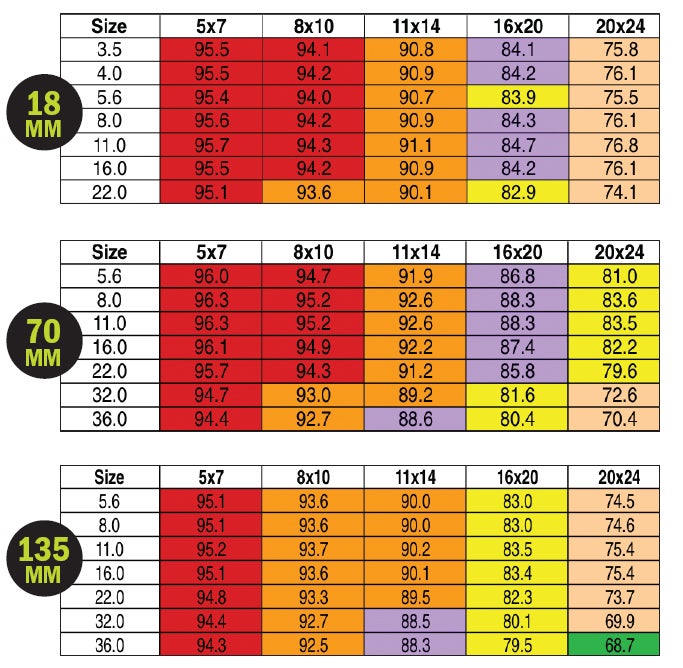
Excellent-range SQF performance at all three tested focal lengths promises pleasing sharpness and contrast. Numbers were just below Sigma’s ($340, street) 18–125mm f/3.8–5.6 OS lens. In our DxO Analyzer Version 3.2 distortion tests, results were average and very similar to those of the Sigma. Light falloff, with no vignetting at 135mm, was also about average for the class.
In our IS tests, three different users gained 2 to 3 stops of handholdable sharpness, slightly better than we expected.
With its compact size, 7.5X zoom range, and decent price— plus IS, subject magnification, and quiet AF—this lens should please snapshooters and enthusiasts alike.