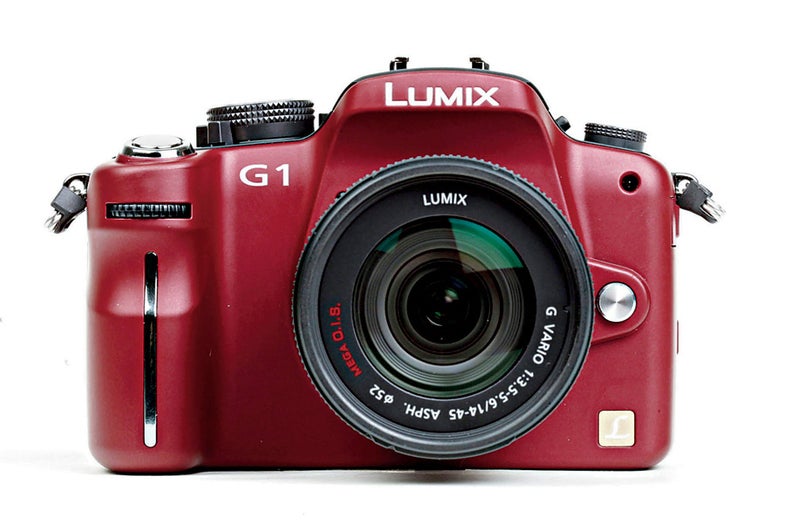
Panasonic's new Lumix DMC-G1 isn't a DSLR. Yes, you can remove the lens, and the camera's $800 street price (with 14-45mm f/3.5-5.6 kit lens) makes it more expensive than some entry-level DSLRs. But this tiny interchangeable-lens electronic-viewfinder model represents an entirely new class of camera.
The G1 is the vanguard of the Micro Four Thirds system, a format meant to bridge superzoom EVFs and DSLRs. The idea: To grab people who want the resolution of a DSLR but the simplicity, small size, and nonthreatening look of an EVF or compact.
The G1 (as with all Micro Four Thirds cameras scheduled to follow) has a DSLR-sized Four Thirds sensor, which captures more detail than the tiny chip inside any superzoom. It's also engineered to be smaller than a typical DSLR and super-easy to operate. And to prove it's not intimidating -- even fun -- it comes in colors (red and blue), as well as black.
WHAT'S THE SMALL IDEA?
A collaboration between Panasonic and Olympus, this new camera and lens system uses a lensmount that's smaller than the one on regular Four Thirds DSLRs from Olympus and Panasonic. With Micro Four Thirds, the distance from the back of the lens to the image sensor is shorter -- there's no allowance for a mirror box and thus no optical viewfinder.
The design also permits relatively tiny lenses, even with lens-based image stabilization. Compared with DSLR glass, Micro Four Thirds optics are about half the size for an equivalent focal length. And as with Four Thirds cameras, there's a 2X lens factor.
By EVF standards, the imaging sensor inside a Micro Four Thirds camera is gigantic. A typical superzoom EVF's chip has a diagonal measurement that's less than half of a Micro Four Third sensor's. What does this mean for you? The possibility of slimmer camera bodies that maintain the resolution and versatility of interchangeable lenses.
The G1 operates very similarly to other EVF cameras: You frame the image using either the 3-inch 460,000-dot LCD or the 1,440,000-dot (equivalent) electronic viewfinder. Much like a digital projector, this EVF rapidly combines separate red, green, and blue frames to create a full color image that refreshes at 60 frames per second.
The result? The highest-resolution EVF we've seen in a still camera. It still blanks out during burst mode, making it difficult to pan along with a moving subject. But it's bright and impressively detailed. The LCD tilts and swivels to make low- and high-angle shooting easier. When focusing manually, both the EVF and LCD zoom in on your subject automatically, as soon as you start turning the focusing ring on the lens. That's an advantage no optical finder can match.

Click to Enlarge 


Print
Stumble It 


Comments
Be the first to comment!