The following interview with Dutch photographer Rineke Dijkstra is exerpted with permission from Image Makers, Image Takers: Interviews with Today's Leading Curators, Editors and Photographers (Thames & Hudson, $36). Written by British-based journalist and critic Anne-Celine Jaeger, Image Makers, Image Takers surveys leading figures in photography to find out what drives and inspires their creative ambitions. In addition to Dijkstra, the book includes insightful interviews with photographers Mario Sorrenti, Ellen von Unwerth, Anton Corbijn, Naomi Harris, Alec Soth, William Eggleston and several others.
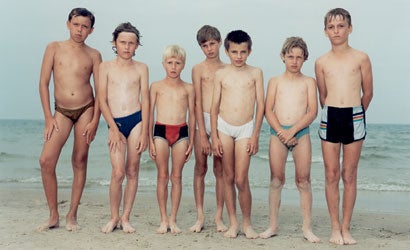
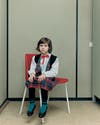
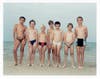
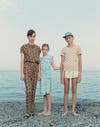
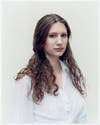
Dutch photographer Rineke Dijkstra tends to work in series, concentrating on individual portraits. She focuses on people in a transitional stage of their life, such as women after giving birth in 'Mothers', adolescents and pre-adolescents on the beach in her 'Beach' series and new recruits in 'Israeli Soldiers'. Her subjects stand facing the camera against a minimal background. The simplicity of the resulting image encourages us to direct all our attention towards the isolated subject. Dijkstra has published two monographs (Rineke Dijkstra: Beach Portraits and Rineke Dijkstra: Portraits) and her work is exhibited in museums worldwide.
| Photo by Rineke Dijkstra/Courtesy Thames & Hudson |
| Click photo to launch slideshow. |
When did you get into photography?
I was studying to be an arts and crafts teacher, but didn't feel comfortable doing that. Then a friend lent me his camera once and I just thought, 'this is it.' I was 19. I did a photography course to learn the practical side of things and then went to Gerrit Rietveld Akademie, an art school in Amsterdam. I've always liked observing. Even as a kid I was obsessed with watching people that looked special to me.
Do you think it's important to be technically proficient?
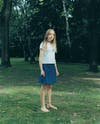
It depends what kind of photography you do. It's important to know the possibilities in terms of what you can do. For example, how I use the flash and light is very important in my images. For me it was a case of learning by doing because I never understood anything they taught me at school. about authenticity. I try to find people that have something special. I don't even know what it is. It's intuition. The pictures of the kids in the Tiergarten in Berlin, for example, came about because those children were actually playing a game and I was simply to get to know them just by observing them when I am taking the picture. I try and look for an uninhibited moment, where people forget about trying to control the image of themselves. People go into sort of trance because so much concentration is needed from both photographer and the subject when you are working with a 4x5. Even the tiniest movement means you have to refocus. I also need to be able to relate to my subject. For example, when I took the portraits of the girls in the Buzzclub in Liverpool, England I could relate tothem. I tried doing the same in other clubs, but it just didn't work.
What interests you about the transition of a person?
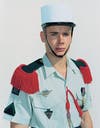
I think photography really lets you examine how a person is changing. When I was photographing Olivier, the Frenchman who enlisted in the Foreign Legion, every time I went to see him I thought he hadn't changed at all. But in the picture you can see the change in his eyes, in his expression. They were subtle, but you could see them clearly.
What do you look for in your subjects?
It's important for me to know the location is right before I approach a subject. Then, I'll find the subject within that location and work from what the subject does. When subjects are posing for me, I don't ever want to manipulate them too much.
What is your aim when taking pictures?
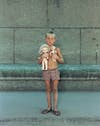
I want to show things you might not see in normal life. I make normal things appear special. I want people to look at life in a new and different way, but it always has to be based on reality. It's important that you don't pass judgement, and leave space for interpretation. For example, in the Almerisa series, the young Bosnian refugee, whose portrait I took for the first time in the early 1990s, it was important for me not to show any specific details of her surroundings such as the décor of the apartment. If you show too much of a subject's personal life, the viewer will immediately make assumptions. If you leave out the details, the viewer has to look for much subtler hints such as how her shoelaces are tied, or her lipstick or the state of her The same goes for the picture of the boy in Odessa.You could show he is poor by including a trashcan or a stray cat in the picture. But for me it's all about subtlety and the fact that you really have to read the image to get clues about the boy.That makes it equal for everybody.
I like it when photographs are democratic. I usually find that portraits work best if you don't have a specific idea of what you are looking for. You have to be open for anything to happen. If you try and force something, there is always the danger of a picture becoming too onedimensional.
| Photo by Rineke Dijkstra/Courtesy Thames & Hudson |
| Click photo to launch slideshow. |
How did you come up with the idea for the 'Beach' series?
I broke my hip about 15 years ago and started doing self-portraits after swimming in the pool where I was doing physiotherapy. I was fascinated by capturing something unconscious and natural in a photograph, something that was miles away from the boring and predictable businessmen I had until then mostly photographed. I was interested in photographing people at moments when they had dropped all pretence of a pose. Once I began taking these pictures, I realized I would prefer to do a series because it gave me a better grip on a subject.

Click to Enlarge 


Print
Stumble It


Comments
Be the first to comment!