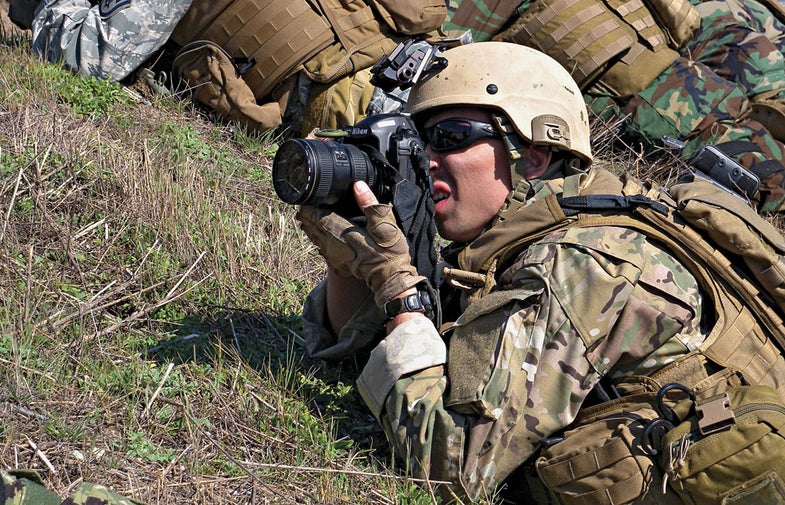
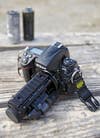
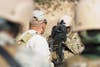
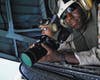
Mass Communication Specialist 2nd Class Derek Sanchez takes photos during Winter Quick Shot 2011 in February 2011 in Azusa, CA.

“We need to beware of mountain lions,” U.S. Navy Chief Mass Communication Specialist David Rush tells me as we wait for his sailors to arrive. Up to now, on this cold, cloudless February evening deep in the Angeles National Forest, my main concern has been simply not getting shot during a live-fire exercise. But now I had another something lethal to gnaw my nerves.
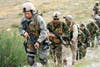
So it’s a relief when the sailors finally approach in the pitch dark, footsteps crunching softly across the dirt of the high-desert canyon. From our vantage point atop a plateau near the target building, I see silhouettes rise up against the distant glow of Los Angeles: Helmet-wearing figures parade single file, M4 rifles at the ready. When the last of the dozen or so have passed, we fall in behind, preparing for what’s ahead.
Tonight’s scenario? Entering a house and apprehending an enemy combatant. The close-quarters battle requires breaching the front door, then securing the building room by room. Even though I expect an explosion to kick things off, my heart and lungs compress when it happens. Men shout what sounds like gibberish. More head-rattling pops punctuate the chaos as flash-bang grenades explode.
There’s not much to see from outside. After a time Rush encourages me to enter the building. The sounds of battle haven’t fully subsided. I poke my head in to discover that the rooms are smaller than New York apartments, so I cling to a wall trying to stay out of the way. They’re using real bullets, after all.
After maybe 20 minutes, the building is secured. I feel freer to roam about photographing the military photographers who are gathering images of maps, cell phones, and weapons. Other service members bring out the now-captured “person of interest,” represented by a wooden mannequin. The exercise over, we regroup and depart silently the way we came.
Trained Shooters
When U.S. Special Forces carry out missions around the world, they sometimes bring along Combat Camera units. These exist in all branches of the military, capturing both video and stills to document operations from beginning to end.
In recent years, U.S. Navy Combat Camera units have come to more fully embody the role their name suggests. Because sailors don’t normally receive extensive combat training, Navy Combat Camera units undergo extra training to fight alongside combat units in all branches of the U.S. military. While they mainly act as the eyes and ears for commanders on the front lines, they’re also warriors ready for action in all kinds of environments from the desert to the high seas, in all kinds of weather.
Unlike embedded photojournalists, who are independent and unarmed even when traveling with and documenting military personnel, Navy Combat Camera servicemen and women can integrate with elite special-forces units.
Their versatility has earned Navy Combat Camera a reputation as the go-to team for documenting critical missions around the globe. Yet battle is not foremost on their minds: Capturing images, both still and moving, is.
Training for Navy Combat Camera involves at least four months of classes in both video and still photography. Besides such fundamental visual concepts as composition and lighting, the classroom curriculum covers all aspects of media workflow from captioning to working with night-vision gear.
In addition, some sailors are chosen to attend a year’s worth of classes at Syracuse University, where they can earn a Navy Enlisted Classification (NEC) as a photojournalist or military motion media specialist. NEC in hand, these sailors usually get assigned to Combat Camera units. Their skills and techniques are then put to the test during an intensive two-week field exercise called Quick Shot.