High school seniors no longer want to graduate with only a cookie-cutter yearbook picture as their legacy.

High school seniors no longer want to graduate with only a cookie-cutter yearbook picture as their legacy. Instead, they’re flocking to photographers for portraits that represent who they are — or who they’d like to be. Case in point: For the photo shown here, Scott Hayne let Chelsea’s windblown hair partially obscure her face, observing, “It’s not your classic senior shot, but kids are looking for images that show their depth.” During a time when people are cautious about money, senior-portrait work now comprises between 20 percent and 45 percent of some wedding and portrait photographers’ business, a dramatic increase from just a year or two ago — and it’s still growing. Hayne, Senior Portrait Artists Artist of the Year in 2009, started his photography business in 2007. In the second year, his senior work went up tenfold, and in the third year nearly doubled that.

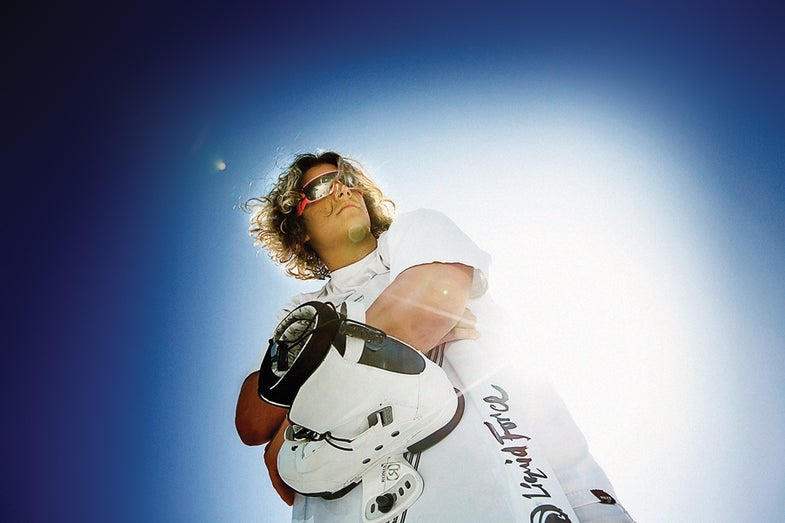
Senior-portrait photographers tend to be already established as general portraitists and, in many cases, wedding photographers. And a significant percentage of them have begun translating the skills and styles popular with those clients to their senior work, including lighting effects, postproduction work and unusual angles. A student might cover half of his face with a guitar or the focus might be on a school ring with the teen blurred in the background. Monarch Photography has become known for such effects as gradient masks, and a trademark look of Scott and Adina Hayne (The Senior Experience) is post-processing textures. As Huy Nguyen of f8studio says, “I think [senior portrait] photographers are becoming aware that they have the power to be creative.”
When working with teenagers, getting to know them is perhaps even more important than with other types of clients. Photographers who go out of their way to discover their subjects’ interests are the most successful at putting them at ease — and getting the most evocative images. Create a fun experience, incorporate elements that make the images very personal, make the students look good — and different from everyone else — and seniors will be happy.
Though most studios are equipped with props that range from old trunks to colorful umbrellas, teens these days are invited to bring props and clothing to the shoot that represent something important to them — a violin, football uniform, camera, ballet shoes, soccer ball or even a car.
Listening to teens’ ideas is also vital. As photographer Tammy Swales points out: “Kids are more vocal and involved than they have been in the past. This generation of kids is media savvy. They are oversaturated with visual ideas, and I think that impacts what they want out of their images.”
Trends in music videos, movies, TV, fashion, advertising and magazine editorials all contribute to what seniors want from their portraits these days. Guys want to look like rock stars or pro athletes. Not surprisingly, girls tend to be fashion oriented, want to look beautiful (of course) and often cite America’s Next Top Model as one of their favorite TV shows. Jonathan Brown and Rosemary Cundiff-Brown of Monarch Photography even say ANTM has been helpful “because it’s easy to draw from that and explain things like an S-curve in posing, or ‘Smile with your eyes.’”
The Browns note that seniors want edgy, editorial shots, like the ones they see in magazines and advertisements for popular brands like Abercrombie and Fitch and American Eagle. When Swales noticed that Teen Vogue used a lot of group poses in their editorials, she incorporated groups (seniors and their friends) into her work to the delight of her clients. She also pushed the envelope, with great success, by using motifs and styling from The Twilight Saga movie series as the basis for a recent shoot with her senior models. As Mike and Heather Krakora of Krakora Studios say, “The trends in popular culture are going to drive the trends for senior portraits,” but knowing how quickly those change, it’s critical for photographers to stay current with what’s going on.
Naturally, it’s important to please parents and grandparents too, so most seniorportrait photographers do take at least some traditional studio shots. While photographers expect kids to bring their favorite trendy outfits, they also ask them to bring one set of clothing that won’t look dated in 20 years so they can shoot a classic portrait for the family. More often the seniors prefer to be photographed on location. Tammie and Chris Billey of Largo Photography say, to satisfy everyone, “We’ll create a natural look for the parents and high fashion for our seniors.”
For location shots, gritty urban settings are popular, report the Krakoras, who add that “a really big trend is to contrast what they’re wearing and the location — girls dressed up, as if for a fashion editorial shoot, but in a location like railroad tracks or a field.” Photographers like the Haynes, with their beachfront studio, find that many seniors want to mix it up and shoot some of their portraits on the beach and others in a nearby urban setting.
Interestingly, though, a few photographers note that studio work will become more prevalent in the near future. They’ll go “back to the basics of studio pro work,” says photographer and educator Ron Kramer of House of Photography and Portranet, “but with fresh, contemporary [editorial] styles.” The Browns also expect to do more studio work, explaining, “Once they [seniors] see the studio work, they really love it because of the manipulation of light.”
See Gallery Of Senior Images
Beyond Still Photos
Video and multimedia slideshows — still images set to music complete with transitions created with programs like Animoto, Showit and Photodex ProShow Gold — are also potential trends in the seniorportraiture market. Though still in its infancy, video’s popularity seems to be increasing. The Krakoras, for example, initially partnered with a local videographer to create live footage of seniors but hope to shoot their own videos in the near future. Right now they’re still researching equipment and technique as well as marketing possibilities, but from their experience, video or Senior Fusion Film seems to be a highly viable — and exciting — opportunity for expanding their senior business.
Swales and Kramer both produce multimedia slideshows but are using them for promotional purposes rather than as a source of income. “I consider them marketing tools,” says Swales. “Once it’s online and their friends see it, the excitement dies. Once parents see it, they don’t need to see it again. I put them out as viral marketing. In the short term, I lose X amount of dollars, but it’s far more valuable [as a marketing tool] in the long term.”
In The Bag
Full-frame DSLRs are the norm for most senior-portrait photographers, usually paired with 70-200mm f/2.8 and 24-70mm f/2.8 lenses. Wide-angle shots are especially hot, and Scott Hayne will sometimes go to the extreme with a 15mm fisheye lens. At the other end of the spectrum, Hayne also shoots with a 100mm macro lens for close-up images. Hayne and Mike Krakora also love the look and bokeh (out-of-focus detail) of 85mm f/1.4 lenses.
Off-camera flash is often used on location shoots, whether with dedicated units such as the Canon 580EX Speedlite or powerful alternatives like the Quantum T5DR. More-complex setups might involve a set of AlienBees monolights. In the studio, photographers use both monolights and softboxes. Jonathan Brown has a four-light Elinchrom studio setup and uses a main light, fill light and, sometimes, a hair light and background kicker light.
Social Media Marketing
Facebook, as Tammy Swales says, “is the single most successful marketing for me, hands down,” and others agree. Whether it’s a fan page for the studio or a personal page (Swales has both), Facebook — and MySpace — is a direct line to seniors. Watermarked images are posted on the photographer’s Facebook page and tagged with the seniors’ names. Then it goes viral, with tagged images appearing on friends’ pages as well. Word-of-mouth recommendations add another dimension to marketing. A number of photographers invite a group of about 10 select seniors to participate in a “senior models” or “senior rep” program each year. Session fees may be waived and other perks are used as incentives for the teens to spread the word among their peers about their photo session. It’s a win/win situation — the kids love being part of a select group, and it costs the photographers little or no expense for effective marketing.
See Gallery Of Senior Images