Camera Test: Fujifilm X-E1 ILC
Fujifilm adds another elegant camera to its ILC lineup
We may earn revenue from the products available on this page and participate in affiliate programs. Learn more ›
Fujifilm’s elegantly retro X-Pro1 wowed us with great images, a cool hybrid viewfinder, and a comfortable set of controls when we tested it for our June 2012 issue. But its slightly sluggish autofocus and irksome manual focusing tempered our excitement. Plus, its $1,700 price tag (body only) put it out of reach for many photographers. Fujifilm’s new X-E1 uses the same APS-C-sized 16.3MP X-Trans CMOS sensor as the X-Pro1, ditches the hybrid finder in favor of a 2.36-million-dot OLED electronic viewfinder, and adds a built-in flash in a physically smaller body—with a nearly identical control layout. While at $1,000, street, body only ($1,400 with 18–55mm f/2.8–4 OIS kit lens), it’s still a pricey camera, but the X-E1 costs hundreds of dollars less than the X-Pro1. Is it worth your dollars? Let’s see….
In the Test Lab
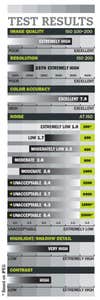
Since the X-E1 has the same sensor as the X-Pro1, we weren’t surprised to see test results very close to those of the earlier camera. Overall, the X-E1 achieved a better rating for image quality, but only because Fujifilm has gotten better at reproducing accurate color with the unique color filter array on its X-Trans sensor. The X-Pro1, with an Extremely High color accuracy rating, had its image quality rating drop to Very High as a result; the X-E1’s average Delta E of 7.9 just makes it past our threshold for an Excellent color accuracy rating and tipped the overall image quality to Extremely High.
In our resolution test, the X-E1 closely matched its sibling. Once again, diagonal resolving power outstripped horizontal and vertical measures, with all three averaging 2370 lines at ISO 200. As we turned up the sensitivity, the X-E1 held on to most of its resolving power, turning in 2300 lines at ISO 1600 and 2200 lines at ISO 6400. Below ISO 200 and above ISO 6400, the X-E1 will not let you capture RAW images, so you’re stuck with JPEGs. Given that, the X-E1 resolved 2320 lines at ISO 100, 2170 lines at ISO 12,800, and 2090 lines at its maximum of ISO 25,600. Not a bad showing.
When it comes to noise, the X-E1 is a tad noisier than the X-Pro1 from ISO 400 and up. At ISO 200, the new camera proved ever-so-slightly cleaner. At ISO 100, however, the X-E1 proved considerably cleaner, earning our highest rating of Extremely Low. It doesn’t take long for noise to rise, though to its credit, the X-E1 keeps noise to acceptable levels up to ISO 1600.
In the Field
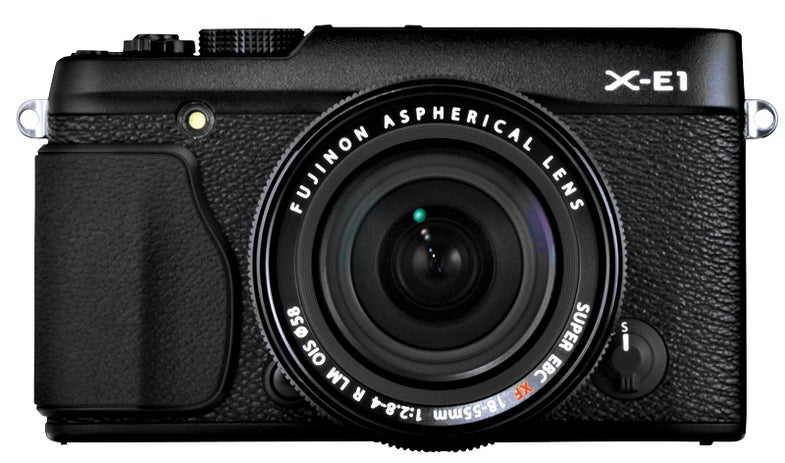
From the outside, the X-Pro1 and X-E1 look nearly the same, aside from the X-E1’s lack of the window for an optical finder. The similarity is exceptionally keen if you opt for the black version of the X-E1 instead of the two-toned silver-and-black body we had for our test.
On the back, Fujifilm moved the playback button to the left of the LCD. The finder also gets a built-in diopter rather than the replaceable finder optics on the X-Pro1. The X-E1’s shutter-speed dial differs slightly in that it doesn’t lock like the one on the X-Pro1. But with its adequate yet not overly stiff detents, and its position recessed from the rear edge of the camera body, we never accidentally turned the dial once in our field testing.
We did occasionally find that the exposure compensation dial would turn when we carried the camera in a camera bag. This easy-turning dial provides a remarkably quick way to bracket manually or to adjust for abnormal lighting conditions. We suggest that you double-check it when you take the camera out of a bag.
As with the whole X-Series, aperture is changed by a ring on the lens, complete with click stops. Focus mode gets a three-way flip switch on the left front of the body. Most other settings can be changed in the quick menu. Meanwhile, any of 13 different settings can be assigned to the function button that sits next to the shutter release. In our field tests, we left this set to ISO.
In our test of the X-Pro1, we noted that manual focusing was less than optimal due to the sluggish rate of adjustment when you turn the focusing ring. Fujifilm has not only made the focusing ring more responsive, but made the action progressive—the faster you turn the ring, the faster the focus changes. So now you can get from one end of the focusing scale to the other with one quick turn. With a little practice, we found the manual focusing quite pleasing. The X-E1’s autofocus is also faster than the X-Pro1’s, but it remains middle-of-the-road for ILCs. Not a problem—just not amazing.
The most useful addition over the X-Pro1 is the X-E1’s pop-up flash. With a guide number of 22 (feet, ISO 200), it’s not super-powerful, but not as overly weak as the ones in many compacts. We were initially confused when we tried to adjust flash-exposure compensation with the camera in its silent mode. Turns out that, because silent mode is meant for those times when you don’t want to be noticed, it disables the flash.
Bottom Line
The Fujifilm X-E1 is a great addition to the company’s line of premium ILCs. Rangefinder diehards might miss the optical finder provided in the X-Pro1, but given that this isn’t a true rangefinder, we were perfectly okay with the X-E1’s EVF. It’s wonderfully crisp, bright, and gives you a good preview of the effects of setting changes. Its refresh rate could be quicker—you’ll notice a bit of stuttering on fast pans—and we wish it didn’t black out during bursts, but it’s among the best electronic finders out there. We’d say Sony’s OLED finders are the only ones that are appreciably better.
If pricing has made you hesitant to enter Fujifilm’s X-Series, the X-E1 might be just the thing to draw you in. And if you’re just looking for a really nice rangefinder-style ILC, you should give the X-E1 a try. We think you’ll like it.
Specifications:
IMAGING: 16.3MP effective, APS-C sized X-Trans CMOS sensor captures images at 4896×3264 pixels with 12 bits/ color in RAW mode.
STORAGE: SD, SDHC, SDXC stores JPEG, RAF RAW, and RAW + JPEG files.
BURST RATE: Full-sized JPEGs (Fine mode), up to 40 shots at 6 fps; RAW, up to 10 shots at 6 fps.
AF SYSTEM: TTL contrast detection with 49 selectable focus areas; single-shot and continuous AF.
SHUTTER SPEEDS: 1/4000 to 30 sec, plus B (1/3-EV increments).
METERING: 256-segment TTL metering, evaluative, centerweighted average, and spot (approx. 2% of viewfinder).
ISO RANGE: Normal, ISO 200–6400 (in 1/3-EV increments); expanded (JPEG only), ISO 100–25,600.
VIDEO: Records at 1920x1080p at 24 fps; 1280x720p at 24 fps in H.264 MOV format; built-in stereo microphone; stereo minijack input; maximum clip length 29 min.
FLASH: Built-in pop-up, GN 22 (ISO 200, feet); flash sync to 1/180 sec.
VIEWFINDER: Fixed eye-level 0.5-inch 2.36-million dot OLED.
LCD: 2.8-inch TFT with 460,000-dot resolution.
OUTPUT: Hi-speed USB 2.0, mini HDMI video.
BATTERY: Rechargeable NP-W126 Li-ion, CIPA rating 350 shots.
SIZE/WEIGHT: 5.0×2.9×1.5 in., 0.8 lb with a card and battery.
STREET PRICE: $1,000, body only; $1,400 with 18–55mm f/2.8–4.0 OIS lens.
INFO: www.fujifilm.com