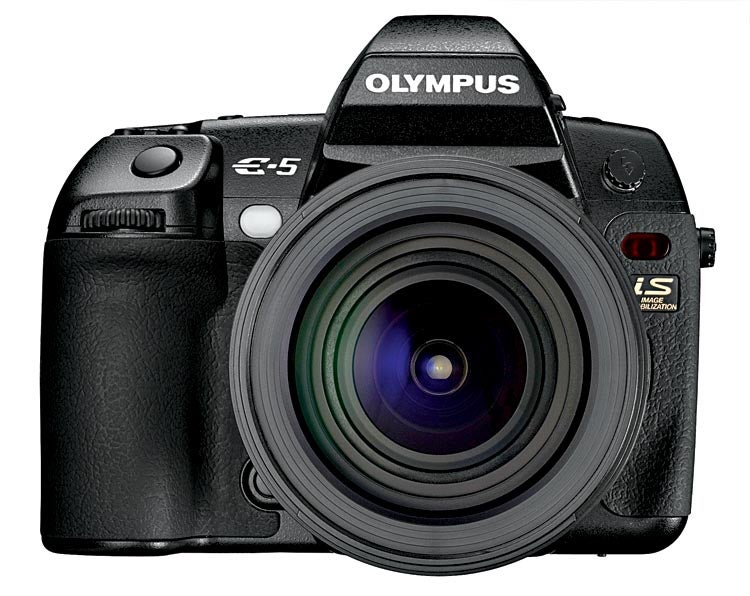
For the past couple of years, Olympus has focused mostly on its Micro Four Thirds line. But, as the new E-5 ($1,700, street, body only) shows, the company hasn’t forgotten about regular Four Thirds at all. The latest update of its flagship DSLR steps up to a 12.3MP Live MOS sensor (from 10.1MP in the E-3), adds a stop of sensitivity for a top of ISO 6400, and adds 1280x720-pixel 30-fps HD video capture. Meanwhile, it keeps the super-rugged magnesium-alloy body with weathersealing that is the top of its class.
In the Lab:
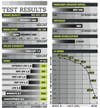
Though the E-5 finds itself on the lower end of pixel counts for cameras in its price range, it still easily managed to score an Extremely High in overall image quality from ISO 100 through ISO 1600 in the Popular Photography Test Lab. Its resolution is the only thing holding it back from reaching an Excellent rating: In the wake of sensors in excess of 20MP in 2008, we were forced to raise the bar in our resolution test, pushing the threshold for an Excellent rating up to 2500 lines per picture height.
The E-5 turned in a very impressive 2270 lines in our test, which is a significant jump from the E-3’s score of 2020 lines. Sure, it trails Canon’s EOS 7D, which achieved 2610 lines, but considering that the 7D has an 18MP sensor, you might expect a bigger difference. Nikon’s D300s, another 12.3MP camera in this price range, managed 2340 lines but also trailed the E-5 in noise performance.
At all sensitivity levels save their shared maximum of ISO 6400, this Olympus had lower noise than the D300s—which says a lot, given that Nikon has been a league leader in noise control in recent years. Both the E-5 and the Nikon D300s had Unacceptable noise levels in our test at ISO 6400, though Canon’s 7D managed to keep noise in the acceptable range at ISO 6400. Still, the E-5 outperformed the Canon in noise control from ISO 100 through ISO 1600.
In our autofocus test, the Olympus displayed a split personality: extremely fast in bright light, but slowing considerably as the light grew dimmer. This may be partially due to the lens we used in the test. Ordinarily, we use an f/1.4 normal lens from the camera’s manufacturer to test AF. But since Olympus doesn’t make a fast normal with a Supersonic Wave Drive (SWD) AF motor, we used the Zuiko Digital 12–60mmf/2.8–4 SWD lens in this test. We considered using the 14–35mm f/2 SWD, but moving its extremely large lens elements can slow down AF, despite being faster glass.
That said, the E-5’s AF proved faster than that of the EOS 7D and the D300s from EV 12, the brightest part of our test, through EV 6, which is about the light level of a well-lit kitchen. Only at levels reaching the equivalent of moonlit darkness did the Olympus fall far behind the competition.