Camera Test: Pentax K-7
A DSLR that makes stepping up simple.
We may earn revenue from the products available on this page and participate in affiliate programs. Learn more ›
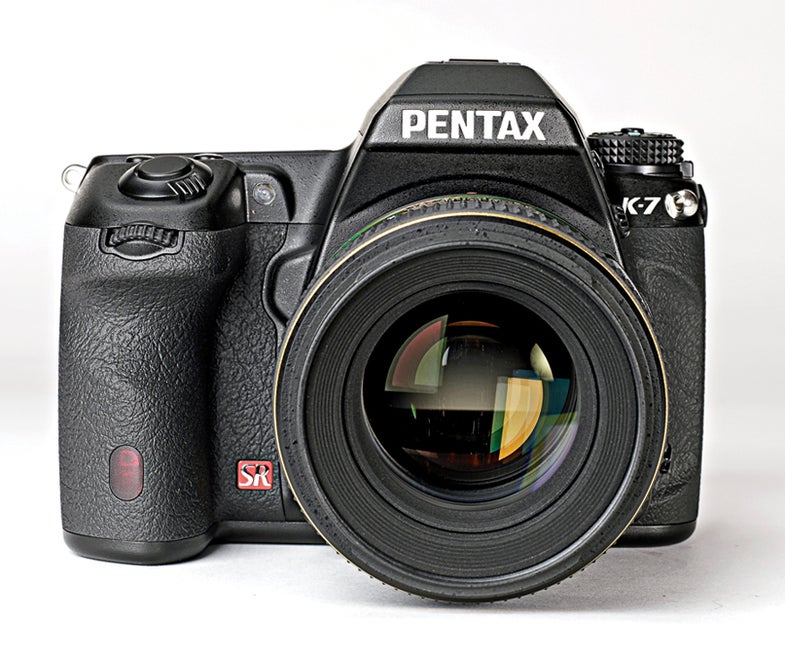
Here’s a ruggedly built, wellsealed DSLR that shoots HD video, processes high-dynamic range (HDR) images in the camera, and has a high-end 100- percent-accurate viewfinder. So why do we have mixed feelings about the Pentax K-7? Because this $1,260 (street, body only) camera is a bit of a mixed bag. The successor to the well-regarded K20D, it doesn’t so much build on the previous model as add a few extensions.
In our lab tests, image quality remained on a par with the K20D’s, with the same tested resolution: 2350 lines. While that’s close to the Canon EOS Rebel T1i ($720, street, body only) and Nikon D90 ($890, street, body only), those competitors beat the K-7’s color accuracy and noise results. Plus, they autofocus faster in middle- and low-level light, and can focus in super-dim light-the K-7 can’t.
A Lot To Like
This doesn’t make the K-7 a bad camera-in fact, it’s packed with extra value.
For starters, the rugged body: a magnesium-alloy chassis covered in a tough, heavily weathersealed plastic shell. There are gaskets at every seam, and rubber seals on the SD card slot and battery compartment. Pentax says you can use it in temperatures as cold as 14 degrees Fahrenheit; the Canon and Nikon are rated only to 32 degrees.
Then there’s the K-7’s 100% accurate viewfinder, which eliminates having to guess what will end up at the edges of your image. Plus, its 0.92X magnification serves up a nice big view.
Add to that the camera’s sensor-shift image stabilization, which Pentax says now compensates for rotational, in addition to vertical and horizontal, movement. This got us between 2.5 and 3 stops of handholding leeway in our tests, allowing you to get a steady image at 1/20 to 1/13 sec when you would normally need 1/100 sec.
Better yet, the IS system works with any lens you put on the camera. We used an adapter to attach a 1950s 35mm f/4 Takumar lens. While we had to focus manually and compensate for exposure readings when stopping down to smaller apertures, the image stabilization worked fine and we got some nice shots.
And the K-7 is a pleasure to use. It’s got a nice body design, with a solid grip and plenty of switches and buttons for the important functions-though we wish they’d kept the IS switch that was on the K20D. Instead, you have to dig into the menus to engage IS-a step backward.
Action shooters should like the 5.2-frames-per-second bursts for up to 40 full-sized JPEGs, or up to 15 of Pentax’s PEF RAW files or 14 Adobe DNG RAW files. That’s faster than both the Rebel T1i and the D90, though Canon’s EOS 50D ($1,070, street, body only), a closer comparison by price, can shoot at up to 6.3 fps-and it outscored the K-7 in color accuracy, resolution, and noise in our tests.
Controlling Noise
In real-world shooting, the K-7’s noise performance isn’t as bad as it seems when in our lab test results. That’s because, as a standard, we test RAW images after processing, using the default noise reduction setting in the manufacturer’s RAW converter. While Pentax’s default applies chrominance NR, its converter applies no luminance NR at all, leaving the amount up to you.
Once we applied luminance NR (20 points behind the default chrominance reduction), noise didn’t reach the Unacceptable level until ISO 6400, 2 stops beyond its level in our test. Our noise-taming didn’t affect resolution much until ISO 3200 (2086 lines, versus 2175 lines at the default settings). At lower ISOs, there was some softness to our noise-reduced images, but still plenty of detail.
So, for less noise, use NR for images shot at ISO 800 and above. More importantly, if you don’t shoot RAW, the issue is moot, since Pentax is more aggressive with its in-camera noise reduction for JPEGs.
Shooting Video
Like many new DSLRs, the K-7 includes high-definition video capture-a choice of standard 1280×720 pixels (720p), or the unusual 1536×1024 or 640×416-all at 30 fps. All three options produced pleasing video.
Contrast-detection autofocus in video is slow, and you can’t manually switch focus points. Ultimately, manual focus was the way to go. The K-7’s other wow feature, in-camera High Dynamic Range imaging, has some limitations.
The K-7 can combine three exposures into a single JPEG (sorry, no RAW) to give you detail in highlight and shadow areas that would be lost in a single shot. Movement can add ghosting, so it works best with stationary subjects and a tripod.
Bottom Line
Ultimately, the Pentax K-7 lands in an odd place in the DSLR world. Its got some high-end features, particularly its tough build and terrific viewfinder. But, its sluggish AF in low light and otherwise middling test results don’t scream “Buy me!” If you’ve got Pentax lenses already, the K-7 is a highly competent camera that will let you build on what you have. But, if you’re an experienced photographer who’s starting a DSLR outfit from scratch, you can get more bang for your buck elsewhere.
IMAGING: 14.6MP effective, APS-C-sized CMOS sensor captures images at 4672×3104 pixels with 12 bits/color in RAW mode
STORAGE: SD and SDHC cards; stores JPEG, PEF RAW, DNG RAW, and RAW + JPEG files
BURST RATE: Full-sized JPEG (Premium mode), 5.2 frames per second up to 40 shots; RAW (12-bit); 5.2 fps up to 15 shots (PEF) or 14 shots (DNG )
AF SYSTEM: TTL phase detection with 11 illuminated focus points (central 9 crosstype); single-shot and continuous with tracking; tested sensitivity down to 0 EV (manufacturer rated to -1EV) at ISO 100, f/1.4
LIVE VIEW: Contrast detection with face detection
SHUTTER SPEEDS: 1/8000 to 30 sec, plus B (1/2- or 1/3-EV increments)
METERING: TTL metering using 77-segment evaluative, centerweighted, or spotmetering; 0-22 EV (at ISO 100, f/1.4)
ISO RANGE: ISO 100-3200, expandable to ISO 6400 (in 1/2- or 1/3-EV increments)
VIDEO: Up to 1536×1024 pixels at 30 fps in AVI Motion JPEG format; built-in mono microphone; stereo minijack mic input
FLASH: Built-in pop-up with TTL autoflash with -2 to +1 EV exposure compensation (1/2- or 1/3-EV increments); GN 42 (ISO 100, feet), covers 18mm lens field of view; flash sync to 1/180 sec; dedicated Pentax hot-shoe and wireless control of optional flash
VIEWFINDER: Fixed eye-level pentaprism LCD: 3-inch TFT with 921,000-dot resolution
OUTPUT: Hi-Speed USB 2.0, mini HDMI video, composite video
BATTERY: Rechargeable D-LI90 Li-ion, CIPA rating 740 shots
SIZE/WEIGHT: 5.1×3.8×2.9 in., 1.7 lb with card and battery
STREET PRICE: $1,260, body only
FOR INFO:www.pentaxslr.com