12 Film Cameras Worth Buying
The tragedy in Japan has made the current DSLR market a scary place, making this a perfect opportunity to get (back) into film
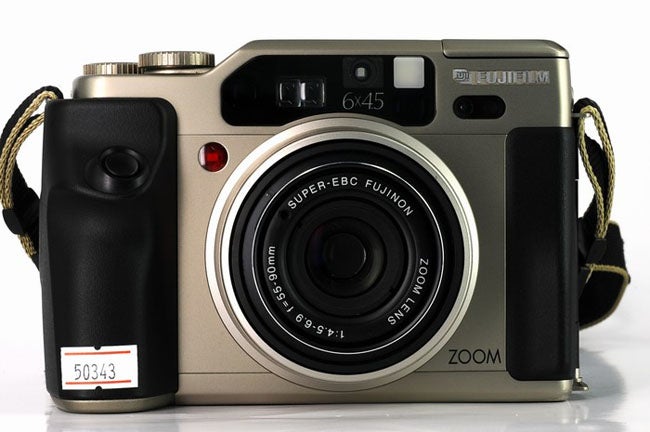
You might not find too many Fujifilm GA645's around, but if you do, this camera is certainly worth a look. A funky looking medium format camera that's relatively small and light—great for travel or hiking into the field—but will get you some of those sweet 120/220 negatives. It has a fixed Super EBC Fujinon 60mm lens (37mm equivalent) and a built-in flash so you don't have to worry about buying accessories. The combination of its compact design, fixed lens, built-in flash, autofocus and hotshoe may easily put this on your watch list. It's a little pricier than we'd like but considering it comes with a lens, it's not a bad deal. Plus, its interesting appearance will probably be enough to draw the attention away from those cocky new X100 owners. Sample Photos:
KEH: from $484 Ebay: from $500 ** ** Craigslist: from $400.
We may earn revenue from the products available on this page and participate in affiliate programs. Learn more ›
Because of the tragedy in Japan, the market for DSLR film cameras is tough right now. Prices of current models are steadily rising while gear that used to be easy to common on store shelves is becoming sparse. Rather than letting the lack of new gear get you down, now is a great time to crack open some film canisters. There are plenty of used 35mm SLR and medium format models on the market at prices that make up for the fact that you’ll have to pay for stuff like film and processing.
We looked at several sources for used equipment including KEH.com, Ebay and Craigslist. KEH.com, if you haven’t heard of them, deals almost exclusively in used equipment but has some new gear as well. Ebay, of course, is Ebay and the usual caveats apply—check the seller’s ratings, return policies, warranties and so on. Craigslist also has some standard caveats that you’re all probably familiar with but, let’s just say that despite how smoothly transactions can go, it’s always a good idea to be cautious. Other options for used gear include Adorama.com and B&H (www.bhphotovideo.com).
It’s worth noting that market prices for film cameras tend to fluctuate pretty wildly, so while our ranges are accurate as of writing, you might end up paying more or less depending on demand and luck.
[Editor’s Note: Keep in mind that this list isn’t exhaustive. There are plenty of other great camera bodies out there hungry for film. This is simply a sampling of some bodies that may work best for someone just getting into film. Some film cameras will work with your current lenses. Some will hold their value like the works of art that they are. If your favorite isn’t on the list, feel free to add it in the comments or send it to us over Twitter or Facebook. Frankly, we see any camera that gets you out and shooting as worth buying right now.]
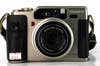
You might not find too many Fujifilm GA645’s around, but if you do, this camera is certainly worth a look. A funky looking medium format camera that’s relatively small and light—great for travel or hiking into the field—but will get you some of those sweet 120/220 negatives. It has a fixed Super EBC Fujinon 60mm lens (37mm equivalent) and a built-in flash so you don’t have to worry about buying accessories. The combination of its compact design, fixed lens, built-in flash, autofocus and hotshoe may easily put this on your watch list. It’s a little pricier than we’d like but considering it comes with a lens, it’s not a bad deal. Plus, its interesting appearance will probably be enough to draw the attention away from those cocky new X100 owners. Sample Photos:
KEH: from $484 Ebay: from $500 ** ** Craigslist: from $400
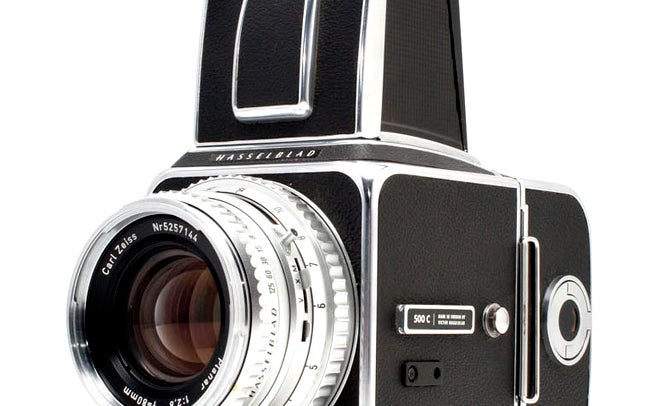
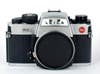
Like the Hasselblad, the Leica represents a level of quality, (and, for some, status) that you won’t find elsewhere. Most Leicas are still priced out of reach, but used R-series (R3, R4, R5) bodies can be had for as little as $79. Granted, the battery check doesn’t work on that particular camera but, still, that’s one helluva bargain. When you pick up a Leica, you can tell it’s built to last. The R-models are built around all-metal bodies and the aluminum die-cast construction is clearly evident. These hard-core cameras are so durable they’ll outlive most of us. Plus, you get that little red dot. Sample Prices:
KEH: from $79 (body only; battery check doesn’t work)
Ebay: from $145 (R3 meter needs adjustment) $435 (R5 with data back); $659 (R4 with 35-70mm lens)
Craigslist: $175 (R3)
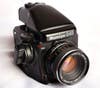
Launched in 1992, the Mamiya 645 Pro has a lot going for it. The camera is well-built, dependable, easy to use, flexible–and those are only a few of the reasons the Mamiya 645 is a good choice if you’re looking for a used medium format camera. Interchangeable backs let you go from 120 to 220 to 135, even mid-roll. With its reasonable pricing, a 645 Pro is still a popular choice among professional photographers. It’s manual focus only, but that’s okay. The Mamiya 645 Pro is a cool looking camera and, if you pick up an AE prism, you can count on TTL exposure. If you really are addicted to AF, you can step up to a used version of the 645 AFD starting at about $950. As the name suggests, it shoots 6 x 4.5 negatives, which is smaller than the 6 x 7 negatives captured by its sibling, the RB 67. That means more photos per roll of film while still giving you a lot more resolution real estate than you get with a 35mm camera. Sample Prices:
KEH: from $94 (with power drive but rated “ugly”); also $172 (body only; excellent condition) Ebay: $300 and up for a complete set-up Craigslist: from $299.95
It’s been called an SLR on steroids by some, for reasons that become immediately apparent when you heft one up to your eye. Because of its size and weight, handholding the camera may be a little difficult and, while KEH offers a super-low price on a model with no mirror lock-up, that’s one feature that you probably want in good working condition to avoid camera vibration. Once you fire the shutter and hear the loud “clomp” made by the mirror, you’ll understand. But this is one rugged and durable medium-format camera, so even models that have been heavily used will hold up over time. And, with the 6×7 format, you get about 50% more usable negative than a 6×6 (3,850 square mm vs. 2,508 square mm). More importantly, though, the Pentax 67’s aspect ratio perfectly matches standard paper sizes so you don’t have to crop (or leave a large border) when printing in a darkroom. The camera takes 120 (10 exposures) and 220 (20 exposures) roll film, but lacks the convenience of interchangeable backs. That said, it also lacks the hassles associated with them. Sample Prices:
KEH: starting at $126 (body only, no lock-up)
Ebay: $320 (body with Pentax SMC 165mm lens)
Craigslist: $354 (body only)
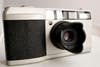
It looks like a point-and-shoot camera because, for all intents and purposes, it is one. But, Ricoh’s powerful little brick does a lot more than the typical analog compact. Legendary Japanese street photographer Daido Moriyama used its fast fixed 28mm lens in ways that make it looks so much more logical than a slow, bulky body. Looking around on eBay, you might be a little surprised to find that the price starts around $300 and can go up from there, but that’s because these little things are sought after for their solid mix of image quality and simplicity. It offers full-auto controls, but you can override that with aperture priority mode. It has AF, but it also allows you to lock the focus on a certain distance, including the hyperfocal distance, a must for serious street photographers. Best of all, it’s big enough to feel like a real camera, but small and subtle enough not to draw too much attention. If you’re into the serious point-and-shoot form factor, you can also check out the Contax T2, which goes for about the same price and offers many of the same features. Sample Prices:
Ebay: Starting at about $150 up to about $400 for one in great shape.
Craigslist: $200 and up