Is there any rhyme, reason or room for 35mm rangefinder cameras in today's ever expanding digital photographic world? Last year camera manufacturers churned out some 6 million DSLRs, which were prominently announced, advertised, written about profusely, and gobbled up by enthusiastic buyers. In the same time period, Leica and Voigtlander quietly sold an estimated 20,000 35mm rangefinder cameras. A drop in the bucket, you might say. And in 2007, these two, now joined by Zeiss, will just as quietly try to expand the breed. It's high time to make a critical, but personal comparison of the species.
Why use a film camera? If you don't know, read Russell Hart's eloquent defense (or is it offence?) in his website column, "5 Reasons to Shoot Film." Why a rangefinder camera? Rangefinder vs reflex is an old battle many of us fought years ago. So as not to get sidetracked fighting it again, I've boxed in the pros and cons, so we can get on to the cameras themselves. And remember, no one said you had to use only a rangefinder, a DSLR, digital point-and-shoot or a film camera. You'll get more out of photography trying as many as you can, instead of sticking to one.
|
Rangefinder Pros
Rangefinder Cons |
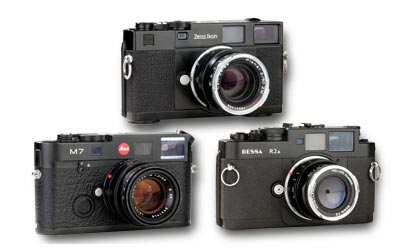
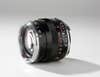
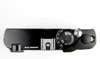
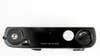
For consistency's sake, I've selected like models in black finish with equivalent lenses from each camera brand. All are manual focus only, have metal bodies, electronically controlled focal plane shutters with manual speeds and aperture priority auto exposure, M bayonet lens mount plus projected lens framelines. These are my favorite models. (However when there are interesting alternatives that I think you should know about, I'll mention them at the story's end). The cameras and lenses are: the Voigtlander Bessa R2A with 50mm f/2 Heliar ($1100), Zeiss Ikon with 50mm f/2 Planar ($2398) and the Leica M7 with 50mm f/2 Summicron ($4395). One item you should know now: Nearly all M lenses are readily interchangeable, but there are no zoom lenses available (although Leica does have two multiple focal length lenses). So anyone who dreams of putting a 50mm f/2 Planar on a Bessa 2A can do it. And all camera bodies and lenses can be bought separately.
We'll hit the salient points that distinguish each camera since there is no way we can do justice to all technical information. I haven't provided measurements because all three camera bodies are practically the same size. Weight is another matter. The Leica is 21.5 oz., the Zeiss Ikon is 16 oz., as is the Bessa.
Use the navigation below to continue reading this article, or the following links to skip to a section: Leica M7, Voigtlander Bessa R2A, Zeiss Ikon, and The Bottom Line.
View through the Leica M7 viewfinder. Click photo to see more images of the Leica M7, Voigtlander Bessa R2A and Zeiss Ikon viewfinders.

Click to Enlarge 


Print
Stumble It


Comments
Be the first to comment!