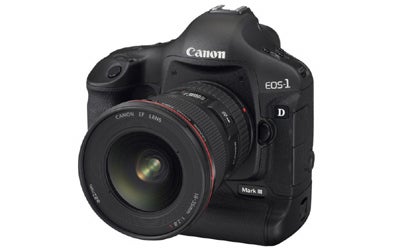
Camera Test: Canon EOS 1D Mark III
What's Hot
• Blazingly fast shutter speed of 10fps
• JPEG+RAW Burst of 22 shots
• JPEG Burst of 110 shots
• ISO 50-6400
• Very Impressive Noise control
• Live View LCD
• 14-bit RAW
• Dual Digic III processing
• Dedicated rear AF buttons
• 3-inch LCD
• Autofocus speed and EV range
What's Not
• High Price
• Weighs a lot
Who's This For?
• You're a pro photojournalist, sports shooter, or wildlife photographer who wants to freeze the action.
• You're a studio photographer looking for live preview and remote control.
• You can afford to spend about $4,000 for the camera body alone.
Competitive Set
• Nikon D2Xs
• Canon EOS 5D
• Canon EOS 1Ds Mark II
Since Canon announced their new flagship 10.1 megapixel high-speed professional DSLR, the Canon EOS 1D Mark III (street: $4500) back in March, we've been itching to put it through our battery of lab tests. Photojournalists, sports photographers and hardcore enthusiasts, among others, have been chattering about this camera online, eagerly awaiting delivery of a promised unit, or complaining about being stuck in back-order hell.
Perhaps you've already heard about the feature set of this camera: ISO 50-6400, 1.3x conversion factor, 10 frames per second with a JPEG burst of up to 110 full-resolution shots (or 22 RAW plus JPEG), Dual Digic III processors, 14-bit analog-to-digital conversion, live preview shooting on the 230,000 pixel 3 inch LCD, sensor-shake dust removal, and a host of other upgrades big and small.
Our impressions with a late pre-production working sample left us on the edge of our seats waiting for a fully testable unit to see if it lives up to the hype. Now that we've run the Canon EOS 1D Mark III through our battery of tests, we can now say we're very impressed with both the features, and the performance, of this new high-speed champ.
Canon traded megapixels for speed with this model. The Nikon D2Xs, another camera in the pro class, captures 12.4 megapixels on a 1.5x crop factor sensor at full resolution at 5 fps, and drops resolution to 6.8 megapixels (and a 2x crop factor) for a high-speed burst of up to 35 JPEGs at 8 fps. The Mark III's full-frame stablemates, the 12.8 megapixel Canon EOS 5D and the 16.6MP Canon EOS 1Ds Mark II, capture images at a more leisurely pace: 3 fps for 60 JPEGs and 4 fps for 32 JPEGs, respectively.
For many a breed of photographer, speed is the name of the game, and the decision to keep the Mark III at 10 megapixels to capitalize on blazingly fast capture and processing with those dual Digic III processors is a tradeoff many sports photographers, photojournalists, and wildlife pros will be willing to make. Life happens in the blink of the eye, and fractions of a second can separate a good peak action shot from a truly great one -- and the Mark III should produce more winners with its blazingly fast burst rate.
In fact, the burst rate of the Mark III is so fast that a series of still images played back on the 3 inch LCD or loaded into Soundslides (video coming soon) feels more like continuous video capture than a series of still images.
IMAGE QUALITY RESULTS, RAW VS. JPEG
Sure, the Canon EOS-1D Mark III is fast -- but how is the image quality? Do you sacrifice quality for speed?
No, not at all. Image quality is Excellent from ISO 50 to 1600 and Very High at ISO 3200 and 6400 (with in-camera high ISO Noise Reduction activated.)
Resolution is Excellent at all ISOs in both JPEG and RAW, ranging from a high of 2200 at ISO 100 RAW to 1850 at ISO 6400 JPEG, with in-camera High ISO noise reduction activated -- a drop of only 16 percent from lowest ISO RAW to top ISO JPEG with aggressive in-camera processing. High ISO Noise Reduction steals a marginal amount of resolution in JPEG images at ISOs 1600-6400, but it's well worth the tradeoff for the noise control.
Noise is Extremely Low at slower ISOs (ISO 50-400) in both RAW and JPEG images, and stays well controlled even as the ISOs keep climbing. JPEG images have much less noise than RAW files processed in Canon's Digital Photo Professional 3.0 at default settings at higher ISOs (See our full test results. And both JPEG and RAW images processed with the In-Camera High ISO Noise Reduction (CF II-2) had better noise control still, with JPEGs showing least noise-Low at ISOs 1600 (1.9) and 3200 (1.8), and Moderate at ISO 6400 (2.8).
Those high-ISO RAW numbers look scary at first glance, but there are so many variables in Canon's Raw Converter, Digital Photo Professional 3.0, or Adobe Camera Raw 4.1, that it's possible to push and pull sharpness and chrominance- and luminance-smoothing sliders to tweak the RAW images to your personally chosen compromise between noise and resolution. But when you're on deadline, the in-camera JPEG processing with High ISO Noise Reduction on does an impressive job of minimizing noise with minimal resolution loss. At ISO 1600, for example, noise reduction steals just about 2 percent resolution, dropping from 2050 to 2000. But noise drops from Low scores of 1.6 to 1.3. At ISOs 3200 and 6400, the noise reduction is even more dramatic, dropping ISO 3200 from Moderately Low (2.3) to Low (1.8) and bringing ISO 6400 out of Unacceptable territory (3.2) to Moderate (2.8).
Color is Excellent in both RAW (Average Delta E: 7.3 ISO 100 AWB) and JPEG (Average Delta E: 7.5 ISO 100 AWB). Our test images showed normal contrast with excellent color in both RAW and JPEG at the neutral setting, which zeroes out Sharpness, Contrast, Saturation, and Color Tone, with very good shadow and highlight details even at higher ISOs. At ISO 100, the Mark III was able to hold detail over an 11 EV dynamic range, and more than nine EVs at ISO 1600 -- quite impressive. Test images showed excellent color fidelity with very little color shift or casting in auto white balance.
In the lab tests, autofocus was Extremely Fast in bright light (EV 12-EV 6) at :33-:40 sec. In moderately low to low light (EV 4-EV1) it was Extremely Fast to Very Fast (:41-:55). At seriously low light (EV 0- EV -2), it slowed down but still manages to find focus when many other DSLRs give up (:96-1:20.)


Print
Stumble It 

PopPhoto
X